


 Loading tweets...


Young refugee the face of World Ranger Day
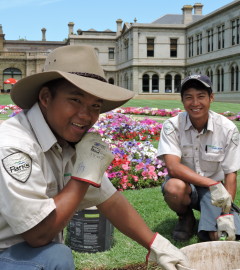
A young refugee who was born in a camp on the Thai-Burma border and who is now following his dream career as a park ranger is the Australian face of this year’s World Ranger Day.
Nay Kaw Wah is based in the Werribee Plains area working from Werribee Park, Werribee Regional Park and Point Cook Coastal Park.
The twenty-one-year-old last year took up a Traineeship in Parks and Gardens with Parks Victoria and GForce employment Training Services.
“It is a dream come true for me and a great opportunity. I love the outdoors and to be working in an amazing environment like Werribee Park is amazing,” Nay Kaw said.
“I love growing vegetables and gardening at home, so this is a dream job for me,” he said.
An ethnic Karen, Nay Kaw was born in the Mae La Refugee Camp on the Thai-Burma border where his family fled, along with thousands of other Karen, after facing decades of persecution and ethnic cleansing at the hands of the Burmese government.
“Growing up in the camp was hard. It was a difficult time. We were not allowed out of the camp, and we were not allowed to work; and sometimes there was not enough food,” he said.
Nay Kaw said he grabbed the opportunity to become a ranger when it came along.
“In a refugee camp there were no examples of careers you could have, only schoolteachers and nurses. We didn’t see anything else because we were not allowed out.
“But when I was in Year 12, I was working in a cabinet factory part time to help my family. At that time, there were six of us in the home and my father has a disability – he lost one of his legs due to a land mine exploding while he was collecting building materials in the jungle,” he said.
“Another Karen ranger at Werribee, Hsar, told me that there was an opportunity to become a park ranger.
“I love the work. Being able to help the community – especially the Karen community. It is important that other Karen see me and Hsar so they know that being a park ranger can be an opportunity for many others in my community.
“I also like working with the all-abilities gardening group and being outside in nature,” Nay Kaw said.
Nay Kaw spoke about his typical day working as a ranger.
“We all start early in the morning at Werribee. The other rangers say ‘good morning’ in Karen which I like very much. First thing we do is safety briefing and day plan, then some of the team open the park where we check gates, toilets et cetera,” he said.
“Then we head off to the community garden to meet with the Karen and African aunties to see if they need any help.
“The rest of the day I could be gardening, doing tree work, mowing with a tractor or working with volunteers. We have so many volunteers in Werribee from many communities, which is great. So, that’s part of my day every day, except for Thursday, when I go to school,” Nay Kaw said.
Nay Kaw said his favourite memories were all linked to nature and the outdoors – including fishing in the nearby Werribee River and camping with his family on the Murray River at Cohuna.
“Like many Karen living here, we love camping in the Australian bush and many Karen teenagers like to go bushwalking – we love it. My first experience with that was as soon as I arrived in Australia at the age of 15,” Nay Kaw said.
He said he recently acquired a surname, something Karen people do not usually have.
“My surname – Wah – is new. Being Karen, we do not have surnames. I got my surname three months ago and it means ‘White’ which is the name of my grandfather,” Nay Kaw said.
“Most Karen surnames that are created are generally connected with a person’s grandparents. For example – people might choose the village where their grandparents were born as their surname,” he said.
Nay Kaw said he would recommend a career as a ranger to other young people.
“My advice would be to ‘take the risk’. It’s a great career and there are many ways of being a ranger, with many different roles,” he said.
“Sometimes in the water on a boat and sometimes gardening and working in campgrounds, and you can work with other communities. Just don’t be scared because there are many team members who help you to learn along the way,” he said.
Founded by the International Ranger Federation in 2007, World Ranger Day is internationally celebrated at the end of July.
It’s a celebration of the important work Rangers do and commemorates Rangers who are injured or killed in the line of duty.
Werribee Park Chief Ranger James Brincat said Victoria’s park rangers come from all walks of life, and their work is as diverse as the environments they manage.
“We’re proud of the work they do every day – partnering with Traditional Owners and local communities to care for iconic landscapes and make sure all Victorians can enjoy the outdoors,” he said.
Read more about World Ranger Day: World Ranger Day – International Ranger Federation