


 Loading tweets...


New program a breakthrough in tackling family violence in diverse communities
A new national program aimed at preventing family violence in multicultural communities was launched recently by the federal Assistant Minister for the Prevention of Family Violence Ged Kearney.
The ‘Many Voices One Future: A Multicultural Approach to Preventing Family Violence’ program is based on eight years of successful work by migrant and refugee settlement agency AMES Australia in building capacity within Victorian migrant and refugee communities to prevent family violence.
The new program comes after an independent review of AMES’ work by consultants Myriad Global found the program was a “significant community-driven model of primary prevention that can set a new benchmark for equity and inclusion in violence prevention”.
AMES is investing $350,000 a year in the new national program that will roll out across the country, beginning in South Australia.
It will embed AMES’ existing model embedded in the heart of settlement, education and community life for newly arrived migrants and refugees.
The program will expand AMES’ community-led model, combining evidence-based pedagogy with deep cultural insights.
The model equips community leaders with the knowledge and resources to become advocates within their communities.
Participants in the program will engage in leadership courses tailored to their needs, ranging from 12-week intensive programs to targeted masterclasses aimed at fostering leadership development, critical discussion, self-reflection and a sense of community responsibility.
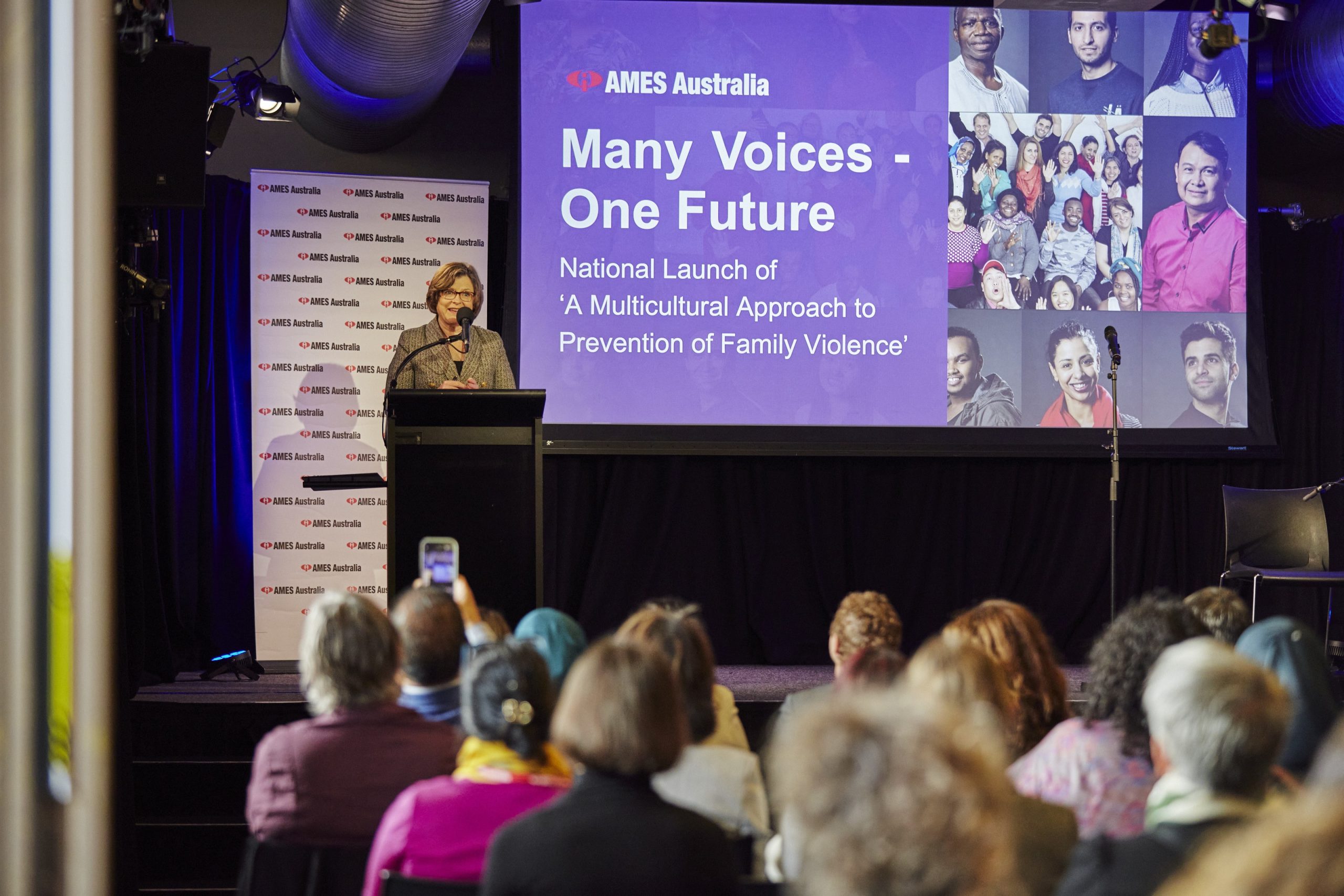 Launching the program, Assistant Minister Kearney said the program was a step forward in filling the gap in the prevention of violence.
“The program is very much part of what’s needed to tackle the problem of family violence. It is grass roots, community based, and it encourages people to be change agents,” Assistant Minister Kearney said.
AMES CEO Cath Scarth said the ‘Many Voice One Future’ program was an important preventative measure.
“It is like building a fence at the top of a cliff to prevent an ambulance being required at the bottom of the cliff,” Ms Scarth said.
“While tertiary services are important, it makes sense to promote preventative programs so that violence doesn’t happen in the first place,” she said.
Ms Scarth told the launch the program would be delivered in trusted environments such as English classes and community spaces. It would be co-designed by participants and create grassroots leadership and community ownership.
The program would be adaptable to diverse local contexts and responsive to intersectional needs, such as language, faith, migration stress, gender roles or experience of discrimination, she said.
It also aims to build national workforce capacity by building pathways for participants from diverse communities into the family and sexual violence sector.
The program includes in-language delivery in mixed-gender cohort settings. It is characterised by peer-led storytelling and trauma-informed facilitation.
Myriad Global consultant and newly appointed Chair of the Settlement Council of Australia Maria Dimopoulos told the launch the ‘Many Voices, One Future’ program was “a moment that really matters”.
“It is a nationally significant. Community driven model that reaches people in the early stages of settlement,” she said.
“It’s a model that has equity and inclusion at its very core and it’s proven to work. This program creates champions who go to transform conversations, challenge harmful norms and lead change in places that mainstream campaigns simply don’t reach,” Ms Dimopoulos said.
AMES family violence program graduate Manal Shebab said the AMES program had equipped her to start her own not for profit organisation working in family violence in her community.
“The training gave me a deep understanding of the complexities and nuances surrounding family violence particularly in the intersection of culture and faith. It also gave me the confidence to start my own not-for-profit organisation Sisters4Sisters in 2018.
“Since its inception, I’ve been an unapologetic advocate for change, challenging rigid ideologies, running awareness and preventions campaigns and creatively partnering with libraries, neighbourhood houses, Islamic societies.
“We saw a gap in resources addressing how to work with faith leaders, across all faiths, so we created a toolkit on preventing and address family violence,” Ms Shebab said.
“The AMES program has really enriched my world and practice, where I can go out and advocate and see a rippling effect because of the program,” she said.
Ms Shebbab said it was important to tailor programs specifically for diverse communities because every community has its different beliefs and practices as well as varying experiences and understandings of gender roles and family structures. Some of these can be really harmful and lead to family violence, she said.
Fellow graduate Arun Thomas said the program had challenged him in the best way possible.
“I learned that violence doesn’t begin with physical harm. It begins with gender inequality, disrespect, silence, and unchecked power,” Mr Thomas said.
“Leadership is not just about what you say, it’s what you’re willing to question and do. As a nurse and migrant, I’ve worked in homes, hospitals, and humanitarian settings. I thought I understood care. But this experience taught me that care without courage is incomplete.
“We must speak up, especially when it’s uncomfortable. I was deeply moved by the stories shared; stories of resilience, strength, and systems that still fail too many women. My commitment moving forward is simple: I will stop assuming intent is enough.
“I will start using every space I’m in – clinical, board, corporate, community – to question inequality and amplify underrepresented voices,” he said.
Recent research by the University of Wollongong found around a third of refugee women in Australia had experienced domestic violence, and many face multiple barriers in seeking help.
These barriers include fear of retribution, concerns about the consequences of disclosure, not wanting to break up the family and economic insecurity.
Refugee and migrant women face additional challenges, such as language barriers, lack of knowledge about Australian laws and services, visa insecurity and complex relationships with communities, the research found.