


 Loading tweets...


New exhibition celebrates 50 years of Australia’s Hmong community
The celebration of Hmong New Year in Queensland’s Logan City exemplifies the capacity of more recently settled Australians to adapt and thrive.
Although the two days of feasting, which coincide with the Gregorian calendar’s Christmas and Boxing Days, are not attended by outsiders, the mysterious cultural practices of this tightknit community may be observed in the exhibition ‘Hmong Journeys: Threads of Home’ at the Living Museum of Logan.
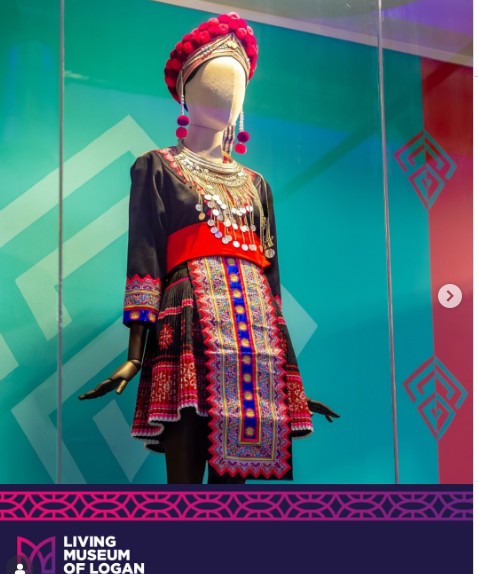 The exhibition’s co-curator, Ms Sarah Thao, said: “This year, 2025, is the 50-year anniversary of Hmong refugees coming to Australia.”
“The whole community was going to create an exhibition for themselves,” she said.
“And I just thought: how can I leverage this opportunity to promote it to the wider community and get them to understand more about the culture and our struggles?” Ms Thao said.
The subsequent showcase of Hmong craftsmanship includes a dozen artefacts, ranging from a musical instrument called a geej to contemporary Hmong necklaces known as xauvs. ‘Xauv’ translates into English as ‘lock’.
Across the collection of jewellery on loan from Ms Mai Yang, an evolution of aesthetics may be observed from the complex filigree of older traditional pieces to the chic modern ones. Yet, maintained is the ethos of remembering the subjugation of past generations.
The centuries long displacement of the Hmong people makes them unique among the refugee communities to have settled in Australia. Their predicament began in the south of China during the 18th century, when the minority group was forced south by an expanding Han empire.
Distinct communities have subsequently developed from Yunnan in South-west China to Thailand in South-East Asia. A number are represented in the ornate garments and headdresses displayed within climate-controlled boxes.
“It used to be like their daily costumes,” Ms Thao said.
“So, there are different dialects in different regions. Their costumes would represent where they came from.
“That’s how they differentiated themselves,” said Ms Thao.
The centrepiece of the exhibition is a contemporary ensemble loaned by dancer Ms Destanie Hang.
The objects on display were by and large obtained from suppliers based in Laos and Thailand, with whom members of the Logan Hmong community continue a dialogue.
Of the heirlooms that have been passed down between generations, is a beautiful baby carrier borrowed from Karen Vang. She was once a passenger, and she continues to use it to carry children of her own. The function of the exquisitely embroidered patterns which embellish these accessories can extend beyond conveying the heritage of their wearers.
“Originally, because Hmong don’t have a written language as such, they used to communicate through textiles,” Ms Thao said.
“So, you’ll see in our costumes there’s a lot of what they called ‘elephant spots’ that kind of look like duck’s feet with two swirls and they all have different meanings. Swirls mean prosperity.
“Back in the days… women weren’t allowed to communicate, and their role was to be homemakers, especially during the time of the war… so they would sit together and this was their way of telling their stories,” Ms Thao said.
Although her people endured many conflicts, it was the aftermath of the Vietnam War, when her Hmong ancestors assisted the CIA, but were later abandoned by the US, which catalysed many families to take refuge in Australia.
Many braved a treacherous crossing of the Mekong River, during which some present-day first-generation Hmong Australians were ferried to safety in carriers.
Stories of survival, including depictions of life in refugee camps, appear in another highlight of the exhibition as elaborately embroidered and appliqued story cloths.
For visitors interested in verbal as well as visual testimonies, the artifacts are generously annotated in the space. The exhibition is also accompanied by a catalogue, which contains interviews revealing the experiences lived by senior members of the Logan Hmong community.
The curator of the Living Museum of Logan, Ms Alice Hinton, believes that the exhibition has received around 16 000 visitors since it opened on 20 September 2025.
Ms Hinton said: “Our purpose at the Living Museum is to have the community reflected in our exhibitions and hopefully share and educate our community on the different and interesting backgrounds, histories, experiences that are had in Logan by our people”.
“So, it’s created by our people for our people, and that’s what we’re all about, and the exhibition really reflects that,” Ms Hinton said.
Visitors and residents to South-East Queensland can come to the Living Museum of Logan and experience the exhibition in person until September 2026.
By Pamela See