 Loading tweets...


SisterWorks stitching together new lives
Next time you get on a Melbourne tram, take a closer look at the upholstery on the seats.
The brightly coloured fabric on the seats is the product of a remarkable initiative that is helping migrant women find work and establish themselves in Melbourne.
Social enterprise SisterWorks, which supports refugee, asylum seeker, and migrant women to achieve economic independence through employment and entrepreneurship, has partnered with Yarra Trams to create a refurbishment project for tram seats.
The project sees migrant and refugee women employed to refurbish the material that form the tram seats.
When a seat is damaged or stained, it is taken out of service and sent to SisterWorks for a multi-stage repair process. Depending on the damage, the sisters replace the fabric and underlying foam and then comfort-test the seat.
What started with just a handful of women has since grown into an enterprise that now sees the SisterWorks team refurbish nearly 80 per cent of Melbourne’s tram seats.
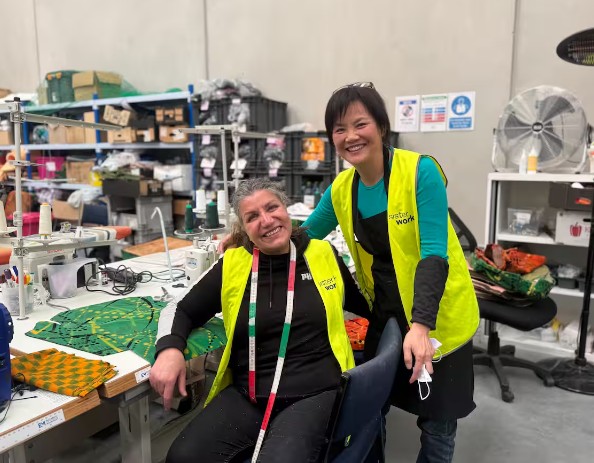 SisterWorks CEO Ifrin Fittock said the women now refurbish around 70 seats each month, which equates to more than 1,500 hours of paid employment each year.
“They are really meticulous in their work, and that’s precisely the skills that are needed to maintain, reupholster and refurbish the Yarra Trams seats,” Ms Fittock said.
“When you arrive in a new country and you don’t know anyone, it’s hard to break through,” she said.
Migrant and refugee women take, on average, up to 18 months to land in employment as opposed to six months for male.
“Some of these women fall through the gaps of the mainstream support services here in Australia, and it’s a shame because many of them are talented,” Ms Fittock said.
Farah Shirkool arrived in Australia in 2012 as a single mother fleeing Iran amid political turbulence, violence and economic hardship.
“I moved to Australia for a better life for my daughter, and because Australia is a very safe country,” she said.
But with a young daughter, limited English and no local support network, Ms Shirkool feared for the future.
Her goals immediate goals survival and independence.
“Money is very important for life; if you have no money, no life,” she said.
Ms Shirkool was referred to SisterWorks by a social worker in 2018.
“The first time I came here, I was very scared. I had spent a lot of timer home after arriving in Australia and I wasn’t sure how to move forward,” she said.
“For the first time, I made friends. I was very happy to find work here because I couldn’t speak English and SisterWorks really supported me,” she said.
After completing English and computer, Ms Shirkool joined the organisation’s manufacturing hub where she rediscovered the of sewing, which she had learned as a teenager in Tehran.
Now Ms Shirkool now works as a sewing instructor alongside 15 other women, who she refers to her as her ‘sisters’.
“SisterWorks is like a family for me, it’s good for the heart. The ladies help me and I help other sisters — it feels very good,” she said.
Over more than a decade, SisterWorks says it has supported more than 3,500 women from 105 nationalities, offering tailored support based on each woman’s skills, background and aspirations.
“Women really are the big fabric of the CALD community here in Australia, and they are an untapped workforce,” Ms Fittock said.
“They’re willing to do their best to succeed and find employment. They want to grow themselves, and be like everyone else – save some money, buy a house, buy a car and send their kids to school.
“Our program helps them to do that,” she said.
The hidden story stitched into Melbourne’s ‘iconic’ tram seats | SBS News