






 Loading tweets...


New Euro agreement on migration a threat to human rights
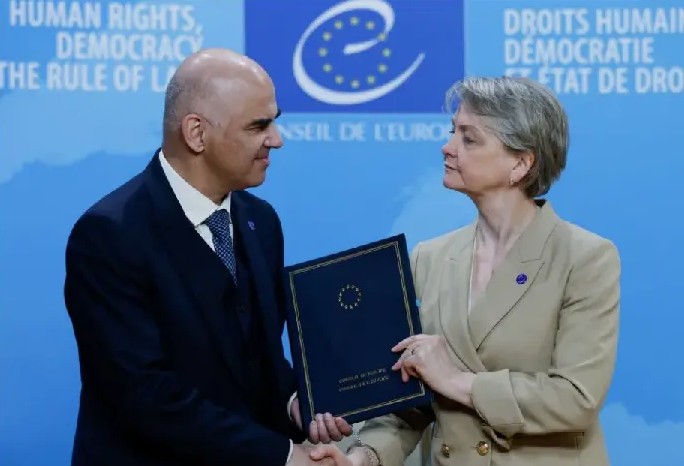
Forty-six European countries, including the UK, have signed an agreement that explicitly endorses plans to send failed asylum seekers to third countries.
The political ‘Chişinău’ declaration from the members of the Council of Europe, the body that oversees the European convention on human rights (ECHR), said states had an “undeniable sovereign right” to control their borders.
 Reports says the UK is now seeking a deal with an unnamed third country to potentially create offshore detention centres.
The political declaration came after calls from some member states for stricter approaches to fight irregular migration and facilitate deportations.
The declaration also says that for states there is both an obligation and a necessity to protect their borders in compliance with the Convention.
It said that nations “exposed to mass arrivals” can pursue new approaches to deter irregular migration including “third country ‘return hubs’, and cooperation with countries of transit.”
But human rights campaigners have said such policies are inhumane and compare them to the deportation policies of United States President Donald Trump.
Spokesperson for the Brussels-based rights group PICUM Chiara Catelli said the declaration could weaken both the court and convention.
“Governments are effectively seeking to pressure an independent Court into weakening long-established human rights protections in order to facilitate deportations, with the risk of deporting people where they could face torture, inhuman or degrading treatment, or where they would stop receiving life-saving medical care,” she said.
“A two-tier human rights system based on migration status is an affront to the basic principle that human rights are universal,” said Eve Geddie, director of Amnesty International’s European Institutions Office.
Italy sent several dozen migrants with no permission to remain in the country to a ‘return hub’ in Albania last year, becoming the first European Union country to send rejected migrants to a nation outside the EU.
The director of the Migration Observatory at Oxford University Madeleine Sumption said the fallout from the declaration was unclear.
“It’s not clear how much impact a political declaration makes given that judges’ decisions are also driven by domestic and international case law, which this declaration does not change. How much concrete difference it will make remains to be seen.”
Human rights organisations said they were concerned by the declaration. Akiko Hart,
Director of the UK NGO Liberty Akiko Hart said: “The Chişinău political declaration on the ECHR is a hugely significant moment”.
“We are deeply concerned that changing how the ECHR is used by UK courts will open the door to a gradual weakening of human rights protections,” Prof Hart said.