


 Loading tweets...


50 years of Vietnamese migration marked
Yarra City Council has unveiled its commemorative marker recognising the 50th anniversary of Vietnamese migration to Australia following the Vietnam War.
The new public artwork honours this significant anniversary and recognises the continuing contributions of the Vietnamese community to life in Yarra.
The marker, called Mythical Crane Boat, was unveiled on Saturday 20 June at Lennox and Butler Street Park in Richmond by Mayor Stephen Jolly, Councillor Mecca Ho and artist Van Phu Le.
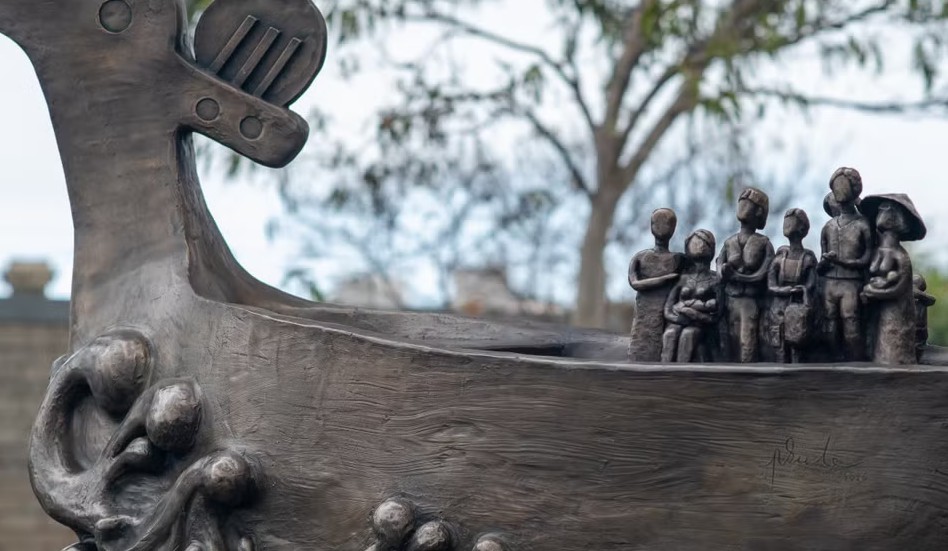
Van Phu Le came to Australia as a refugee in 1981, and his experience as a refugee has informed this work.
“The boat, shaped like a mythical crane, symbolises the Lac Viet lineage, rooted in ancient legend, the crane represents wisdom, resilience and freedom,” Phu Le said.
“When danger arises, it does not confront blindly — it turns, navigates, and finds the path to safety. Like generations of Vietnamese people who, when faced with danger and loss, set out across unknown seas in search of freedom.”
The unveiling of this marker is years in the making, beginning when Vietnamese community members approached Council in 2024 to request Council recognise the 50th anniversary.
A Community Project Consultative Group was appointed in 2025, and it has guided the entire process of the marker’s development with cultural advice and knowledge.
The arrival of refugees from Vietnam fifty years ago changed Australia refugee policy.
The fall of Saigon to North Vietnamese communist forces, sparked a massive exodus of refugees, many of whom ended up in Australia.
The event marked the end of the Vietnam War and the reunification of Vietnam as the Socialist Republic of Vietnam under communist rule in July 1976.
On April 26, 1976, the first boatload of refugees fleeing Vietnam sailed into Darwin Harbour, heralding a series of arrivals over the next few years.
The Fraser government’s policy to accept refugees from Indochina meant that the vast majority of refugees from Vietnam arrived by plane after selection by Australian officials in refugee camps established throughout South-East Asia.
The ‘boat people’ era was a seminal moment in the history of migration to Australia. Prior to the fall of Saigon, most refugees accepted were from Europe in the post-World War II years.
Afterwards, Australia began taking refugees from conflicts and authoritarian regimes across the globe.
The skipper of the first boat to sail into Darwin harbour, the 20 metre Kein Giang, was Lam Binh. His greeting to the immigration officials who came aboard was: “Welcome on my boat. My name is Lam Binh, and these are my friends from South Vietnam and we would like permission to stay in Australia”.
Twenty-year-old Lam, with his younger brother and three friends, made the 3,500-kilometre journey to find refuge.
Lam was not a professional sailor. He taught himself navigation as part of his escape plan. His original map was just a page torn from a school atlas and, while a better map was acquired later, it extended no further than Timor. Lam and his friends sailed the rest of the journey by dead reckoning.
But the very first Vietnamese refugees to reach Australia were the orphan infants evacuated by ‘Operation Babylift’ in the weeks before the fall of Saigon in April 1975.
Amid fears for their safety, more than 3,000 infants were flown out of Vietnam, mainly to the United States, United Kingdom and Canada, but also to Australia.
Australians were supportive of Operation Babylift; with the Australian Women’s Weekly magazine running a two-page article in April 1975 that emphasised the impact of the war on Vietnamese children.
Prior to 1975, there were around 700 Vietnam-born people in Australia, mostly tertiary students, orphans, and wives of Australian military personnel who had served in (South) Vietnam. Refugee resettlement occurred during 1975-1985, followed by family reunion. By 1981, 49,616 Vietnamese had been resettled in Australia.
The exodus of refugees from South Vietnam continued. In 1977 boats carrying 21,276 people arrived in neighbouring South-East Asian countries and Hong Kong. In 1978 there were 106,489 arrivals and, in the first six months of 1979, another 166,604.5
These figures record only the number of people who arrived in refugee camps, not all those who attempted to leave Vietnam. Many people were captured in their attempts to escape.
Dangerous seas, overcrowded or unseaworthy boats, and pirate attacks meant that an unknown number of refugees perished at sea.
In his best-selling memoir, well-known Australian comedian and artist Anh Do recounts that his family was twice attacked by pirates.
The increasing numbers of refugees put a serious burden on Vietnam’s nearest neighbours.
Many refugees recounted how they would arrive by boat in a neighbouring country to seek sanctuary, only to be refuelled, sometimes given food, and sent back out to sea. Lam Binh and his party were moved on several times before deciding to try to reach Australia.
In the international negotiations that took place to try to manage the refugee situation, Australia promised to take an increased number of refugees, but only if South-East Asian nations would stop their practice of redirecting boats.
Since 1976 Australia has become home to a thriving Vietnamese community. The 2016 national census showed that 219,357 people in Australia were born in Vietnam.