



 Loading tweets...


Rohingya refugees face a new threat
Almost a decade after fleeing Myanmar, Rohingya refugees living incamps in Bangladesh are facing a new threat from extreme weather.
Heavy monsoon rains have triggered landslides and floods at Cox’s Bazar, killing at least 17 people.
Aid agencies warn that overcrowding and poor infrastructure are leaving refugees increasingly vulnerable.
Earlier this month heavy rains triggered a landslide at a Rohingya madrassa (school) in a camp in southeastern Bangladesh, killing eight children and injuring five others.
The landslide buried the madrassa under mud and debris after days of heavy rain. Rescuers recovered 13 children from the madrassa.
Several rain-triggered landslides have hot camps in recent weeks.
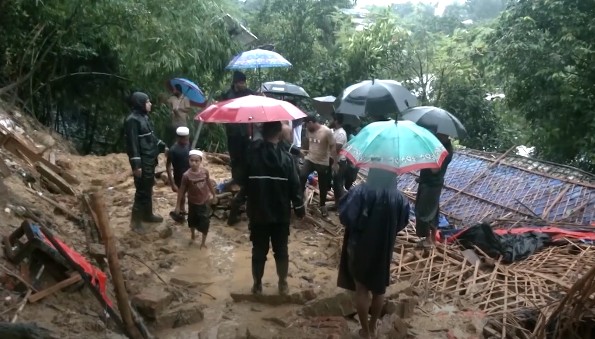
Most families live in makeshift bamboo-and-tarpaulin shelters on steep, deforested hillsides that are vulnerable to landslides during the annual monsoon season.
Authorities have been relocating families from high-risk areas as heavy rainfall increases the danger of landslides.
The Bangladesh Meteorological Department has forecast more rain in the coming weeks, and officials remain on alert for landslides and flash floods.
More than 1.2 million Rohingya refugees live in overcrowded camps in Cox’s Bazar, the world’s largest refugee settlement, after fleeing a 2017 military-led campaign of genocide in neighbouring Buddhist-majority Myanmar.
The exodus of Rohingya from Myanmar began in 2017 after a military campaign against them, described by the UN as ‘ethnic cleansing’.
Myanmar’s military, the Tatmadaw, unleashed waves of violence against Rohingya ethnic minorities in Rakhine State.
The conflict triggered the exodus of more than 700,000 Rohingya into neighbouring Bangladesh, marking the largest and fastest influx into the country.
Most fled to Bangladesh, resulting in the creation of the world’s largest refugee camp at Cox’s Bazaar, while others escaped to India, Thailand, Malaysia and other parts of Soth and Southeast Asia, where they continue to face persecution.
The Rohingya who stayed in Myanmar following the attacks continue to face violence at the hands of the Tatmadaw.
They are suffering poverty, rights abuses, discrimination, and exposure to armed conflict.
The Rohingya also face restrictions on their movement, limited access to essential services, and deep-seated prejudice based on their ethnicity and religion.
The Rohingya are believed to have migrated from what is now Bangladesh to Rakhine, then known as Arakan, during the 17th century.
When Myanmar gained independence from British colonial rule in 1948, the Rohingya were left stranded in Rakhine state; no longer Bangladeshi but viewed by the newly-independent nation of Burma as outsiders.
They were denied citizenship under Myanmar’s 1982 Citizenship Law, effectively rendering them stateless.