





 Loading tweets...


We are living through a deadly time for aid workers – report
The past two years have been the deadliest in decades for humanitarian aid workers, according to a new report.
Released to mark World Humanitarian Day, the ‘Aid Worker Security Report’, compiled by the Aid Workers Security Organisation, shows violence against humanitarian personnel rose again last year, with Gaza and Sudan the two places most affected.
The report says 1,187 aid workers were victims of major security incidents in 2025 with 350 killed, 322 wounded, 235 kidnapped and 280 detained or arrested.
Fatalities fell slightly from 2024, but the number of kidnappings and serious injuries pushed overall violence higher than ever before.
Kidnappings by non-state actors and criminal groups nearly doubled from the previous year to 235, with serious injuries also increasing.
Local staff make up the vast majority of people those affected, yet reports say they still have less access to resources and protections than international personnel.
One example is Yemen, where dozens of local UN staff have been detained by the Houthis for two years and now face death sentences.
“The trend of state actors as the predominant perpetrator of violence continued into 2025, although attacks by non-state actors and criminal groups rose as well,” the report said.
“Road travel remained the most dangerous setting for aid workers, accounting for 27 per cent of all violent incidents in 2025.
“Organisation offices, compounds, and project sites accounted for a further 20 per cent of violent incidents, highlighting a continued failure of warring parties to respect humanitarian operations and infrastructure,” the report said.
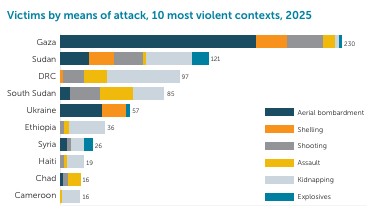
It said Gaza remained the deadliest context for aid workers in 2025, with 186 killed, 68 per cent by aerial bombardment, despite a fragile ceasefire.
“In Sudan, continued intense conflict drove up fatalities for the fifth year in a row, with a record 71 aid workers killed, mostly from small arms fire,” the report said.
“Other high-insecurity contexts in 2025 included Ukraine, Ethiopia, Syria, Haiti, Chad, and Cameroon, where the most commonly known means of violence were kidnappings and aerial bombardment.
“DRC experienced the largest increase in violent incidents affecting aid workers, doubling since 2024. Ukraine also had a marked uptick driven by expanded drone warfare. After a decline in 2024, South Sudan returned to high numbers of violent attacks consistent with 2021 and 2023.
“Yemen, South Sudan, DRC, Myanmar, and Palestine together accounted for 75% of state detentions and arrests of aid workers, with Yemen alone recording a third of all aid workers detained in 2025,” the report said.
It said there is growing criminalisation, control, and distrust of aid in some insecure regions that have added to the risks and complexities of humanitarian work. This has reduced the access and acceptance humanitarian groups have built over decades,
“Countering these trends requires legal, diplomatic, and operational responses from organisations and governments that will be difficult to mount amid deep funding cuts and the retreat of Western donors from humanitarian aid,” the report said.
World Humanitarian Day recognises aid workers and calls for their protection.
Read the full report: HO_AWSD_2026_Figures.pdf