






 Loading tweets...


Distilling the immigration debate – a sober look at the facts
The political debate around migration has reached fever pitch in Australia with vested interests chiming in to protect their own turf.
The febrile debate is helping fuel the rise of Pauline Hanson’s anti-immigration One Nation as a political force that is challenging the coalition and the government.
In this environment it is important use evidence and facts in talking about migration to bolster public confidence in the migration system.
ANU academics Professor Alan Gamlen and Professor Peter McDonald have pointed to some important consideration in developing a coherent immigration policy for Australia in a series of recent articles.
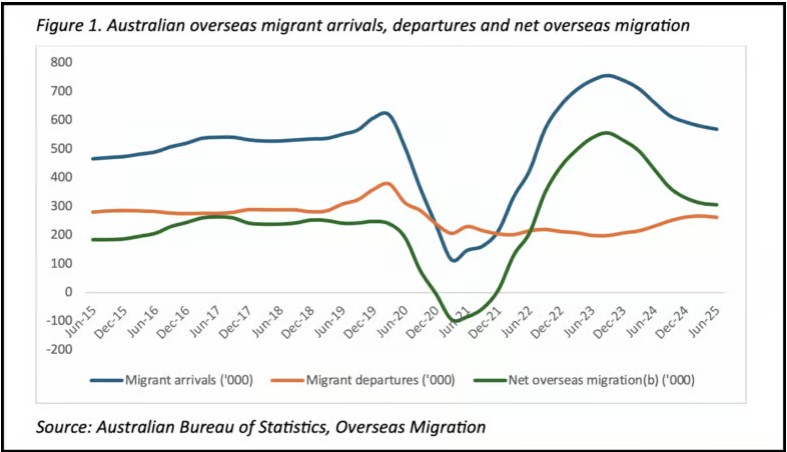
The first thing they point to is the impact of the COVID-19 pandemic on migration.
“COVID suddenly interrupted both arrivals and departures. When borders reopened, arrivals recovered quickly, but departures responded more slowly. Students, working holidaymakers and other temporary residents whose stays or pathways had been extended during the pandemic continued moving through the system,” the professors say.
They term this a “migration splash”.
“Movement was first suppressed, then released in a sharp rebound that overshot before beginning to settle. Net overseas migration has already fallen substantially from its post-pandemic peak and is forecast to decline further.”
They say the tasks at hand is not to stem migration but ensure that the return to normal levels is “orderly, credible and durable”, including by carefully managing delayed departures associated with pandemic-era visa extensions and disrupted migration pathways.
The professors say that the use of ‘Net overseas migration’ (NOM) as a catch-all measure and policy lever is wrong.
NOM is the difference between migrant arrivals and migrant departures.
They say the measure is an accounting outcome, not a program governments can set with the same precision as the permanent migration intake.
“Governments can influence NOM through visa grants and settings, processing priorities and the conditions governing entry, stay and departure. But they cannot simply declare a number and expect the system to produce it precisely.,” they say.
Public confidence could be lost by announcing NOM targets without explaining how entries, transitions and departures will be managed.
Instead, governments need credible mechanisms for governing the migration system.
“This distinction matters because net migration is the aggregate outcome of many very different forms of movement. Framing NOM itself as the problem invites imprecision and encourages the false conclusion that all migration is problematic. That is simply not the case. Addressing the things people actually care about requires greater precision than a single net migration figure can provide,” the professors say.
Another point they make is that the immigration debate is framed through a view that Australia still operates a traditional settlement system centred on a small, carefully planned permanent program.
In reality, this program is accompanied by a much larger and demand-driven temporary migration system, which includes international students, temporary skilled workers, working holidaymakers, visitors and bridging-visa holders.
“Temporary migration is economically and socially valuable. The problem is not temporary migrants. It is that temporary residence has expanded without an equally clear plan for settlement or departure,” they say.
“This leaves too many people changing visas repeatedly, waiting in queues or remaining in prolonged uncertainty. It also complicates housing, infrastructure and service planning and increases vulnerability to labour exploitation.
“The temporary system has mushroomed partly because of deregulation that occurred 25 years ago in a different era. And he should clarify that Government now needs the regulatory capacity to govern that system more deliberately. Government needs mechanisms that allow it to regulate volumes without manufacturing enormous application backlogs.”
The pair suggest that for some temporary visa categories, prospective applicants could first pass through a low-cost registration, expression-of-interest, pre-screening or ballot stage.
Those selected could then be invited to lodge a full application. This would allow government to regulate application volumes while avoiding the costly and unfair practice of accepting large numbers of applications that cannot be processed promptly, they say.
Also among their proposals is that the government should decide how many complete applications it can realistically assess before encouraging people to invest substantial time and money in applying. These mechanisms should be transparent, reviewable and tailored to the visa category concerned.
Also, temporary visas need a clear purpose, a credible duration and defined routes either to permanent residence or departure, the pair say.
“People legitimately change employers, form relationships, seek protection or become eligible for skilled permanent residence. Reform must distinguish these valid transitions from practices designed mainly to delay departure,” the pair say.
And they say delaying or denying partner visa applicants and refugees should not become convenient way to lower the NOM number.
“The objective should be a temporary system with clear rules and predictable endpoints, not arbitrary delays that leave families and vulnerable people in limbo,” the professors say.
Permanent and temporary migration programs can’t be managed separately, they say, with the size and composition of the permanent intake being considered partly in relation to the temporary population already in Australia.
“A temporarily larger permanent program can, counterintuitively, help reduce pressure on the temporary system by converting established residents rather than leaving them cycling through provisional visas. Permanent places should therefore give appropriate priority to suitable people already living, working, paying taxes and contributing in Australia,” they say.
The professors also make an interesting mathematical point, saying onshore conversion to permanency does not add another person to the population, rather, it changes the status of someone already here.
It also provides greater certainty to employers and communities and reduces the need to recruit another person offshore to fill the same permanent place.
A rising number of people applying for student and family visas from within Australia has led to a boom in bridging visas over the past three years, increasing the challenges of managing migration.
More than 410,000 people were om bridging visas last month. Bridging visas are temporary visas that are issued to people whose main visas have expired and are waiting for a decision on their next visa application.
Ther 410,000 figure was more than double the number three years ago and now represents about 14 per cent of all temporary visa holders in Australia.
In conclusion, the professors say immigration is not “out of control” but it also is not without problems.
They say the post-COVID surge in migration is receding, but it has also exposed a migration system designed to control permanent settlement while allowing temporary residence to expand without adequate regulation.
The task now is to “complete the post-pandemic stabilisation, build effective controls over temporary migration, and reconnect temporary entry to deliberate decisions about settlement and departure”.
“That is a more credible response to public concern than chasing a single NOM number. It preserves the benefits of migration while replacing short-term numerical theatre with a system that government can actually govern,” the professors say.