


 Loading tweets...


Forgotten displacement crises identified
A new report has identified the most neglected displacement crises across the globe where the world has largely turned its back on human suffering.
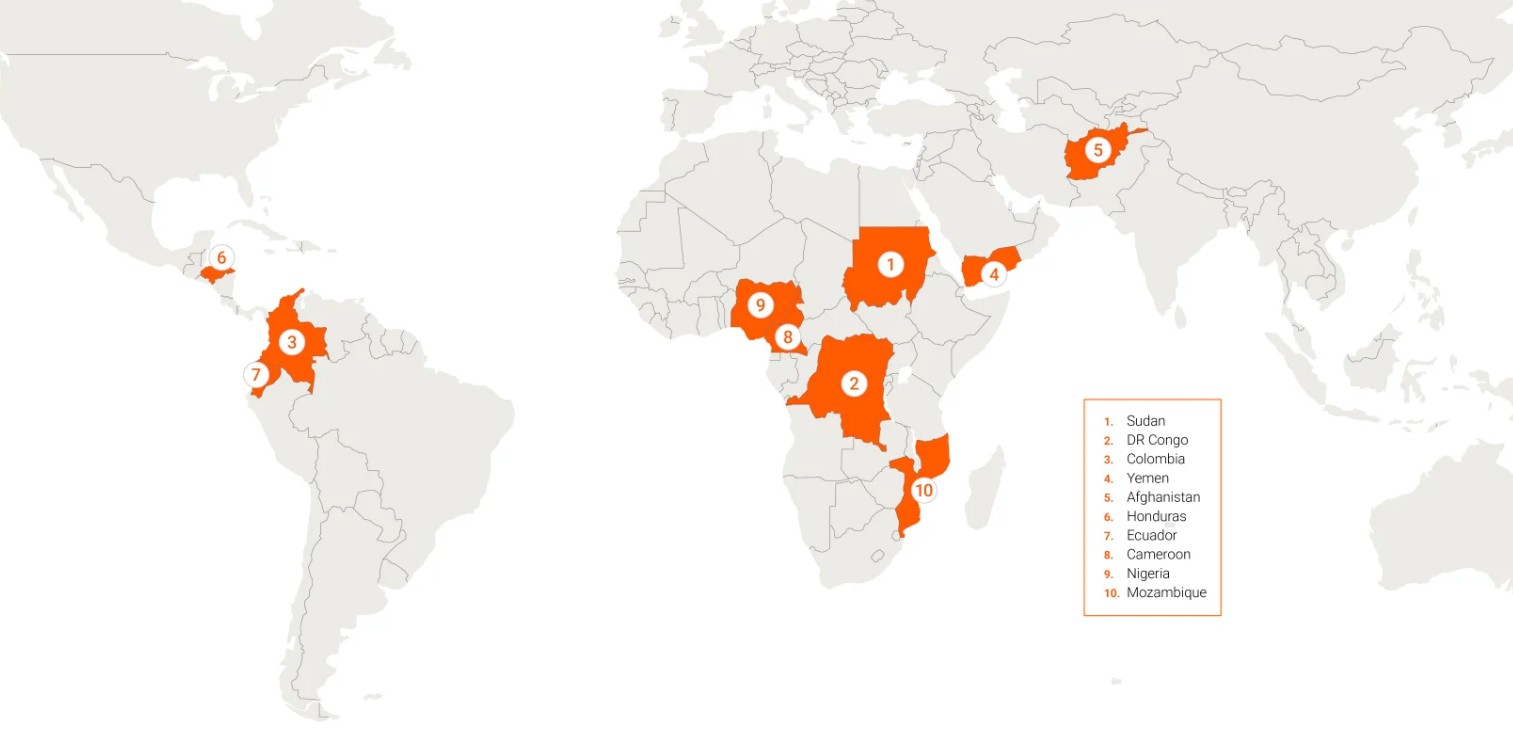
The ten most ignored displacement and humanitarian crises have been arrived at using four metrics: media attention, funding, political will and scale of displacement.
The report, now in its tenth year, produced by the Norwegian Refugee Council, identified Sudan, Democratic Republic of Congo, Colombia, Yemen, Afghanistan, Honduras, Ecuador, Cameroon, Nigeria and Mozambique as the ten most forgotten crises.
These countries are both conflict zones and the hosts to large numbers of displaced people.
Sudan
Population – 46.8 million, People in need of humanitarian support – 30.4 million
By the end of 2025, the world’s worst humanitarian crisis had entered its thousandth day of war.
“Nowhere on earth are more people suffering, and nowhere is the gap between need and action greater, making Sudan the most neglected displacement crisis,” the report says.
Brutal conflict has left nine million people displaced within the country. Almost 29 million people faced acute hunger in 2025, with several areas experiencing active famine.
“Sudan’s war flickers on the global diplomatic agenda, only to fall away just as quickly. Political efforts to quell the conflict have mostly been performative and apathetic, unable or unwilling to take tangible action to protect civilians or ensure humanitarian access,” the report says.
DR Congo
Population – 117.8 million, People in need of humanitarian support – 21.1 million
The country’s history has been marked by armed conflict since 1996. Thirty years on, over 200 armed groups vie for control, and violence, displacement and poverty have become part of everyday life for communities across the country.
2025 marked a painful deterioration for eastern DR Congo. Fighting intensified in North and South Kivu provinces, forcing families to flee repeatedly, sometimes three or four times within a single year.
“A brutal year was met with an aid response that was only 27 per cent funded, marking the lowest level of funding for DR Congo since 2016. Health clinics were forced to close, protection services were cut back, and food aid was reduced,” the report says.
Colombia
Population – 53.21 million, People in need of humanitarian support – 9.1 million
Colombia’s armed conflict has been raging for over 60 years. Nearly a decade after the historic peace agreement was reached, over nine million people continue to live under the influence of organised armed groups.
In 2025, more than 155,000 civilians in rural areas were forced into confinement by armed groups – a tactic used to exert control over territory. People were trapped in their homes, unable to move freely for weeks on end. Daily life, in its most basic form, came to a halt.
One and a half million people were impacted by the ongoing conflict and violence in 2025 – three times more than the previous year. Humanitarian funding struggled to keep pace.
Bordering Venezuela, Colombia is also host to 2.8 million refugees and migrants, making it the world’s third largest hosting country. Yet, it received less than 10 per cent of the funding needed to support them.
Yemen
Population – 34.9 million, People in need of humanitarian support – 19.5 million
For more than a decade, Yemen been consumed by one of the world’s worst humanitarian crises.
By the end of 2025, more than 18 million people – over half of Yemen’s population – faced acute food insecurity.
Water scarcity threatened millions more, as deteriorating infrastructure and climate shocks left entire communities without reliable access to safe water. Nearly half a million people were severely affected by flooding alone.
“An estimated 7.6 million people did not have adequate housing or household items – the majority living in conditions so appalling, they would have made headlines anywhere else in the world,” the report says.
“Years of economic fragility have had cascading consequences. Teachers can no longer afford to remain in their jobs because of the lack of salaries. Without teachers, children cannot be educated,” the report says.
“Without educated graduates, there are no doctors to provide healthcare, no technocrats to govern, and no teachers to replace those who left. The collapse of one system accelerates the collapse of others.”
Afghanistan
Population – 46 million, People in need of humanitarian support – 22.9 million
Five years after the Taliban’s return to power, Afghanistan’s crisis is intensifying. Communities already affected by decades of war and political unrest are forced to endure catastrophic earthquakes, extreme poverty, mass deportations from neighbouring countries, and systemic restrictions on women’s rights.
Around half the population of Afghanistan requires humanitarian assistance.
Against this backdrop, Afghans are being forced to return from Iran and Pakistan. In 2025 alone, 2.9 million Afghans returned to their country, many under coercive conditions. Having fled in search of safety, they are now arriving back with nothing. These returns represent a significant protection failure.
“Since the Taliban returned to power, almost 100 edicts have been issued limiting women’s and girls’ access to education, work and public life. Without female doctors, women’s healthcare collapses. Without female aid workers, women become unreachable,” the report says.
Honduras
Population – 10.8 million, People in need of humanitarian support – 1.6 million
“For over a decade, Honduras has been dealing with a three-pronged crisis: insecurity, climate shocks and forced displacement,” the report says.
“Within the country’s main cities, invisible borders drawn as part of criminal violence remained, trapping people within neighbourhoods and bringing everyday life to a dangerous standstill,” it says.
Healthcare, schools and jobs have become harder and harder to access as people are prevented from moving beyond their own street.
“During the dry season, forest fires swept through nearly 60,000 hectares of greenery across Honduras, while extreme autumnal rainfall damaged urban infrastructure,” the report says.
“When funding shortfalls forced a global hyper‑prioritisation in June 2025, Honduras did not make the cut. The humanitarian response was thus only 11 per cent funded, and the country entered 2026 excluded from international humanitarian response planning,” it says.
Ecuador
Population – 18.3 million, People in need of humanitarian support – around 500,000
Ecuador is an addition to this year’s report as a middle-income country famed for the Galápagos Islands and a reputation for stability in a turbulent region.
Ecuador has long been overshadowed by the crises of its neighbours but that has recently changed.
“Not a single day has passed without a murder in Ecuador since 2021, and in just a few years the country has become the most violent in Latin America. In 2025, homicide rates rose by 40 per cent compared to the previous year.” The report says.
Throughout last year, more than 100,000 people were estimated to have fled their homes.
Violence in Ecuador has become endemic. Organised groups mark territory using local landmarks – such as homes, businesses, and sports facilities – which residents learn to read as risk zones.
The daily lives of thousands of people have been severely disrupted. Even schools, once places of safety, have become recruitment grounds for criminal groups.
“Ecuador hosts nearly 440,000 refugees and migrants from Venezuela, a commitment that deserves recognition. A significant shortfall in international funding, however, has made it harder to sustain support for a government contending with overlapping pressures,” the report says.
“Stronger engagement from the international community, donors and national authorities cannot be delayed. This includes greater investment in the integration of people seeking safety within Ecuador, alongside more robust policies to protect and assist victims of violence,.” it says.
Cameroon
Population – 29.4 million, People in need of humanitarian support 3.3 million
“Cameroon continued to face a complex and protracted humanitarian crisis in 2025. Violence in the Far North, Northwest and Southwest regions persisted, forcing thousands of people from their homes and limiting access to essential services,” the report says.
Ongoing arrivals from the Central African Republic in the east of the country have placed additional pressure on already fragile systems.
“Around three million people were in urgent need of humanitarian aid by the end of the year, while ten per cent of the population was reported to be acutely food insecure. Prolonged and frequent displacement and rising living costs have eroded families’ ability to afford the basics of daily life,” the report says.
The number of people displaced across Cameroon climbed to over 1.5 million by June 2025. The scale and severity of the crisis rose while funding fell, and the humanitarian response for the year was only 24 per cent funded.
Nigeria
Population – 229.2 million, People in need of humanitarian support 7.8 million
Africa’s most populous nation, Nigeria, also has one of the continent’s largest economies. It is a cultural powerhouse that boasts a globally influential film and music industry, and a fast‑growing tech sector.
The vibrance of its cities, however, stands in sharp contrast with the prolonged crisis dominating the country’s north.
The north-east is contending with a 17-year-long armed conflict, which intensified profoundly in 2025. Non-state armed groups killed at least 4,000 civilians.
“The north-west faces organised criminality that has displaced thousands, destroyed livelihoods and driven some of Nigeria’s worst malnutrition rates. Meanwhile, intercommunal and farmer-herder disputes claim the country’s middle belt, forcing tens of thousands of people to flee their homes, and killing many others,” the report says.
With the humanitarian response only 31 per cent funded, the gap between needs and resources in 2025 is vast.
Mozambique
Population – 34.9 million, People in need of humanitarian support – 1.3 million
Mozambique’s crisis is worsening. Insecurity is forcing schools to close, and a generation of children has been left without education and without options. For many, armed groups offer the only sense of structure, income or belonging in a world that has left them behind.
The conflict that has been raging since 2017 grew in both geographic reach and severity in 2025.
“People who were forced to flee found little footing in host communities throughout 2025. Scarce land, dwindling resources and a lack of assistance only deepened the burden on families already living beneath the poverty line,” the report says.
“Many were driven to move again and again in search of income. Others chose to stay or return home, weighing the risk of insecurity against the risk of starvation,” it says.
“As the frontlines of the conflict shifted and spread, the roads leading to the most vulnerable communities grew increasingly dangerous, cutting off essential aid. Funding that was already inadequate in 2024 fell even further, and the total humanitarian response was only 23 per cent funded in 2025.”
Overview
 Director General of the Norwegian Refugee Council Jan Egeland said the international “neglect” of these displaced populations was “a choice”.
“Neglect is a choice. The fact that millions of displaced people are cast aside, year after year, without even basic support and resources, is in no way inevitable,” Mr Egeland said.
“It is the sum of choices made in the capitals of wealthy nations that could easily take a different approach, but largely choose not to,” he said.
Read the full report: The world’s most neglected displacement crises | NRC