




 Loading tweets...


Politicians, community celebrate 180 years of Australia China links
At a time of uncertainty driven by military conflict and subsequent concerns over resource scarcity, it can pay to know who you can rely upon.
On the Thursday prior to ANZAC Day weekend, numerous parliamentary ministers and Chinese community representatives converged at Queensland’s Parliament House to reinforce a bond that dates back to 1848.
Brisbane’s Chinese Consul-general, Mr Ruan Zongze, said, “This world is not peaceful, less stable, Peace and stability is kind of a dream we’re working for…
“However, Australia and China, we are very much committed to achieving this kind of a dream,” Mr Zongze said.
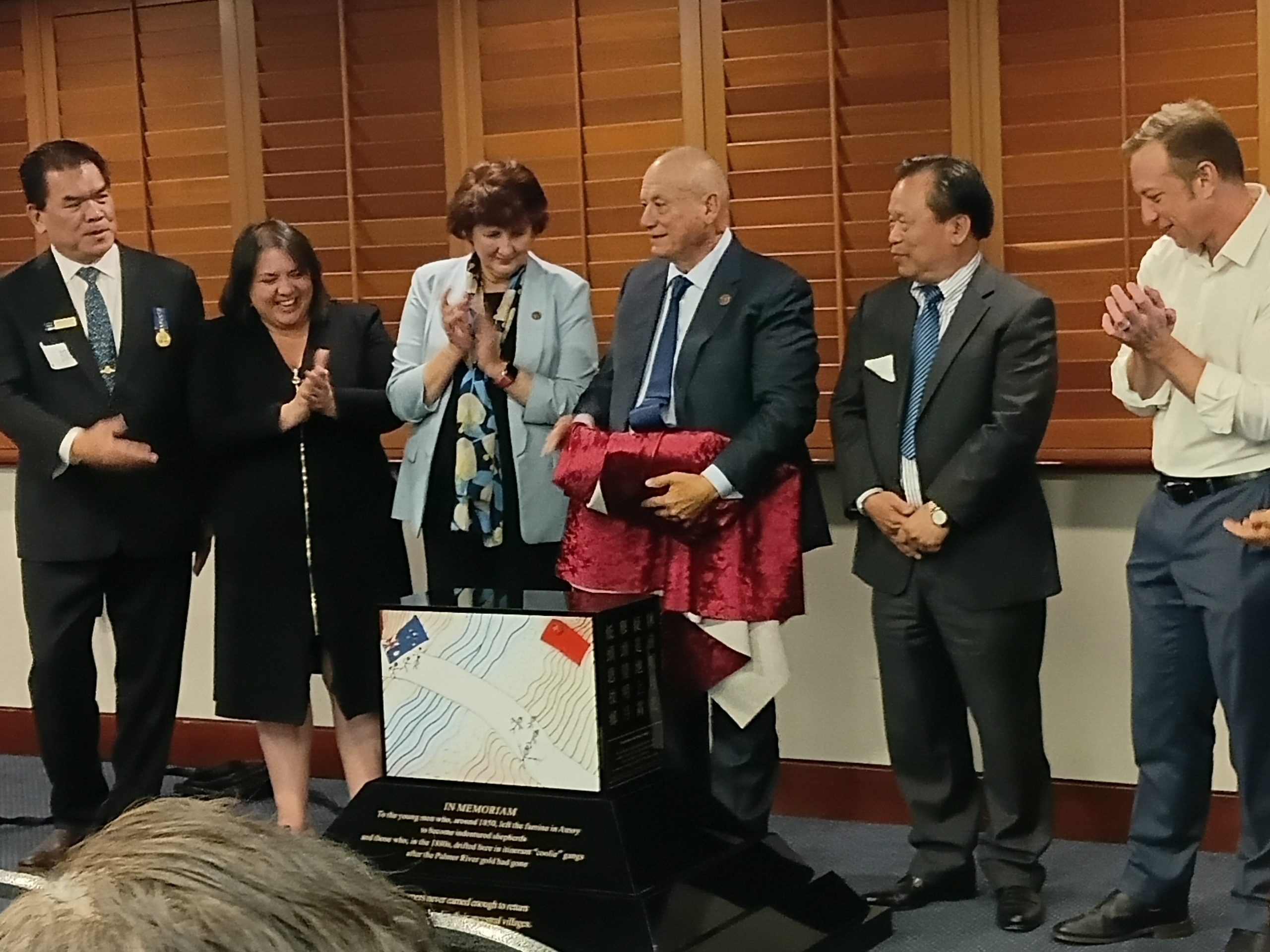
The occasion was the unveiling of the portable St George Memorial SCCMC Portable Memorial by Peter Russo MP for the Queensland seat Toohey.
The original, which was built by Wing Hing Construction, features an illustration by Kamilaroi school student Rory (formally Daisy) Brown, was installed in St George Cemetery early 2019.
Honorary Chairman of the St George Chinese Community Memorial Committee (SCCMC), Mr Lewis Lee explained, “Why? because there was a brush fire in 1970… burned down all the grass”.
“And, also there are no headstones… the headstones all burned down,” he said.
“We found that on the Balone council records it’s all ‘Chinaman, Chinaman, Chinaman’.
“That’s why we came back and formed a steering committee,” said Mr Lee.
Contemporary diaspora communities raised over $70,000 in a year and a half to honour this first ‘organised movement of labour from China’.
“The Amoy shepherds come to the Darling Downs minding sheep,” Mr Lee said.
“Most, if not all, did not see their families again. The SCCMC stands to honour the spirit of their sacrifice,” Mr Lee said.
An Aliens List compiled by police in 1913 suggests that the Chinese residents of St George, at that time, were by-and-large Cantonese.
However, it’s heartening to see acknowledgement of this earlier group of Chinese emigres, which pre-dates the Gold Rush.
‘Amoy shepherds’ is a term typically associated with a group of indentured labourers sent from present-day Xiamen in Fujian province between 1848 and 1853 by firms like the British Tait & Co.
The period falls within an interlude between military conflicts that have become known in the English vernacular as the ‘Opium Wars’.
Between 1850 and 1851 alone, over three hundred of them arrived in Moreton Bay, with the primary agent for their importation, Robert Towns, purportedly declaring
that he “saved the colony from ruin” though Chinese labour.
Their contribution to the establishment of Queensland, with its pre-Separation reliance upon wool for economic stability, cannot be overstated.
In 1846, the population of the then Northern districts outside of Brisbane was approximately 1300 and the pastoralists were unable to recruit sufficient shepherds.
Prior to the establishment of St George in 1862, the locale fell into the geographic region of Maranoa and the police district of Drayton (modern-day Toowoomba).
So How was amongst the indentured labourers to arrive in Queensland in 1849, contributing as a shepherd and “cooking for all kinds of stations” until his admission to the Dunwich Benevolent Asylum at the age of 75 years.
Perhaps reflective of the reception received by Amoy men, many also freely chose to settle in the “the jewel of the diadem of squatterdom”.
The circumstances surrounding the 1847 arrival in Australia of Amoy-born one-time “miner”, Benhab’s, remain unclear.
However, the Darling Downs resident of four decades went on to run a fruit store and hold the distinguish role of Warwick Town Crier.
SCCMC Committee members explained that the scaled down, portable, version of the St George based memorial would serve to broaden awareness of the Amoy Shepherds of their region.
However, the Amoy indentured labourers were initially contracted for five-year periods across present-day Brisbane, Ipswich, Beaudesert, Maryborough and Rockhampton.
In addition to shepherding, they were imported to fulfil a broad range of tasks from horse breaking to making tallow.
Subsequently, it may serve to appease their restless souls and offer a place of solace for their innumerable descendants across the state.
Mr Zongze said, “I think that Chinese community has played a tremendous part in Australia’s history, culture, society… And, I’m sure that will play an even bigger role in the future.
“And, I think they have become a bridge, a strong connection between Australia… and China… people to people engagements are extremely important.”
By Pamela See