


 Loading tweets...


Stories of resilience aired at Refugee Week event
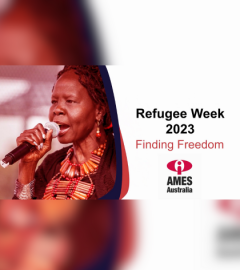
The contributions of refugees in Melbourne were the focus of a recent event held at Federation Square to mark Refugee Week.
The event saw three refugees share their stories of displacement, resilience and determination to rebuild their lives in Australia.
Facilitated by migrant and refugee settlement agency AMES Australia with the support of Federation Square, the Department of Home Affairs and City of Melbourne, the event, titled ‘A Million Stories of Us’, saw about 80 people from across the city gather to hear the stories of people with lived experience of displacement.
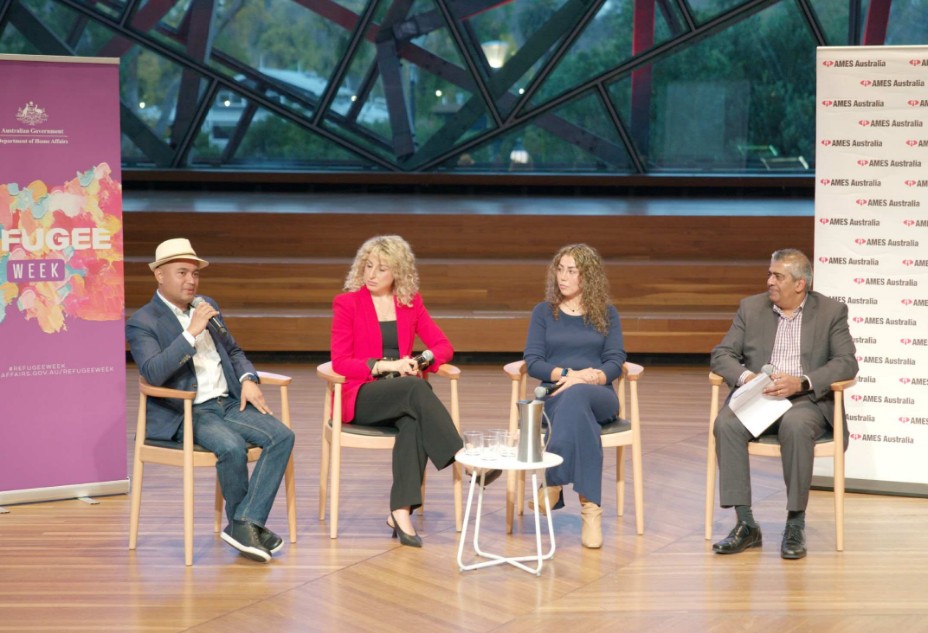
One of the panellists was Afghan refugee Nahid Kazemi, who is now a Senior Case Manager with AMES Australia’s refugee settlement program.
She supports refugees who have just arrived, helping them settle into life in Australia and feel safe, confident and connected.
“My work is shaped by my own experience. My passion is to help individuals and families find housing, access services, and build a sense of belonging. Our work helps people not just to settle, but to feel welcome, respected and part of their new communities,” she said.
Nahid spent a decade in Malaysia as an asylum seeker before being granted a humanitarian visa to come to Australia.
Another speaker was Jamila Alarkan, an engineering and operations leader in the renewable energy sector.
After fleeing conflict in Syria, Jamila continued her studies under extremely challenging wartime conditions before arriving in Australia, where she rebuilt her career from the ground up with limited English and no local experience.
“My experience as a refugee has shaped my career. I am passionate about supporting refugees and women to forge careers in the engineering sector,” Jamila said.
Beyond her technical leadership, Jamila is Chair of Women of Worley ANZ and Mongolia, where she champions gender equity, mentors emerging leaders and advocates for greater inclusion across the sector.
Johny Adhikari worked for over a decade with NGOs and agencies fighting to expose the growing human rights crisis created by shadowy criminal gangs operating scam factories on the Thai-Burma border.
The researcher and advocate told the event of his work to support and secure the release of the trafficked victims of the brutal gangs.
“After I was threatened by some of the gangs, I was forced to take my family to safety. I applied for a humanitarian visa through the UN and was resettled in Australia,” Johny said.
Johny is now studying a Certificate III course in Community Service at Victoria University, while also continuing to support the organisations working to free the scam factory victims. He aims to find work in the human rights or community development sector.
AMES Australia Director of Settlement Support and Community Care Gerard Murren told the event that refugees had helped build modern Australia economically; and they have added to the vibrant multicultural society we enjoy today.
“But our celebration comes at a time when refugee resettlement is currently going through a really difficult period across the world,” he said.
“At the moment there are more than 117 million people forcibly displaced globally – that is one in every 70 people on the plant or equivalent to the population of Japan.
“Seventy-five per cent of these people are living precariously in low and middle-income countries.
“The number includes about 30 million people designated as refugee by UNHCR and almost 70 million internally displaced people.
“But at current rates, just half a per cent of these people will ever be resettled in safe third countries because many nations have drastically reduced their intakes of refugees.
“At the same time, funding for global humanitarian work has been decimated.
“Over the past couple of years more than 30 per cent of global humanitarian funding has disappeared – driven largely by the US’ effective axing of foreign aid.
“Australia stands in stark contrast to this. As nations increasingly close their borders to refugees, Australia continues to accept 20,000 refugee each year – a number that is, per capita, amongst the highest intakes in the world.
“Our settlement system is generous and sophisticated and provides to refugee families all of the services that ordinary Australians can access,” Gerard said.
Home Affairs Assistant Secretary Zoe Williams told the event that this year marked 75 years since the signing of the 1951 Refugee Convention, which established modern refugee protocols.
“Australia was instrumental in creating the convention and was one of the first signatories,” Ms Williams said.