






 Loading tweets...


World hunger growing – UN report
Global hunger continues to grow fuelled by a growing number of conflicts, according to a new report.
The tenth annual ‘Global Report on Food Crises’, published by the United Nations, found that in 2025, around 266 million people across 47 countries and territories faced crises or acute food insecurity, requiring urgent humanitarian assistance.
“Overall, 22.9 per cent of the analysed population in 47 countries/territories – corresponding to 266 million people – experienced high levels of acute food insecurity. This marks a marginal increase from 22.7 per cent in 2024,” the report said.
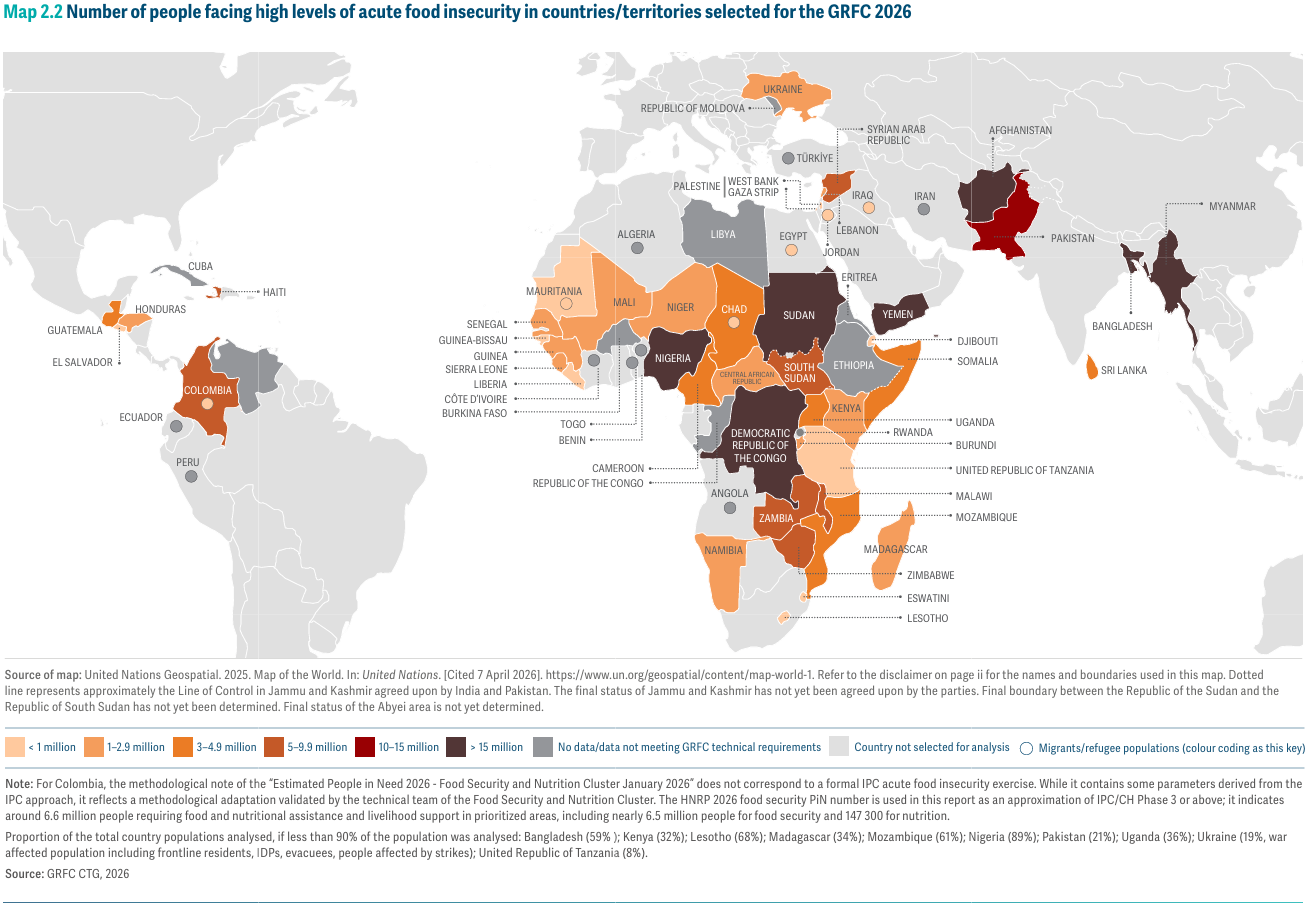
The 266 million figure – lower than the 2023 figure of 282 million people – reflects a reduction in the number of countries covered in 2025, compared with 2024, rather than a fall in hunger.
The rising trajectory of hunger across the globe is clear because in 2020 the number of people facing acute food insecurity was just 155 million.
Afghanistan, South Sudan, Sudan and Yemen ranked among the largest food crises globally, in both relative and absolute terms.
And famine was confirmed in two countries/territories in 2025; in parts of the Gaza Strip and Sudan – a first since the reporting began.
The report said more than 80 per cent of people facing high levels of acute food insecurity lived in protracted crisis contexts (33 countries/territories), where recurrent shocks and structural vulnerabilities continue to drive persistent food insecurity.
“Conflict and insecurity were the primary drivers of acute food insecurity in countries/territories hosting more than half of the population facing high levels of acute food insecurity. Countries with weather extremes as the primary driver accounted for around one‑third of the global number of people in high acute food insecurity. Economic shocks were the primary driver in fewer contexts compared with 2024,” it said.
“In 2025, humanitarian and development financing to food sectors in food crisis contexts both declined, against a backdrop of persistently high global acute food insecurity. Funding has fallen back to levels last observed in 2016–2017.”
The report estimated that around 35.5 million children were acutely malnourished across 23 nutrition crisis countries, including just under ten million with severe acute malnutrition.
About 9.2 million pregnant and breastfeeding women were acutely malnourished across 21 countries/territories.
The number of forcibly displaced people in the 46 countries/territories decreased slightly to 85.1 million in 2025, 74 per cent of whom were internally displaced. Globally, the majority of forcibly displaced people are in food‑crisis contexts.
But some countries saw meaningful improvement.
“Bangladesh saw a significant 32 per cent decrease in acutely food-insecure people between 2024 and 2025, and Syria reduced its share from 39 to 29 per cent of the population – though both remained at alarming absolute levels,” the report said.
UN Secretary General Antonio Guterres said that hunger was increasingly being used as a weapon of war.
“Conflict remains the primary driver of acute food insecurity and malnutrition for millions around the world, with outright famine emerging in two conflict‑affected areas in the same year – an unprecedented development,” he said.
“At the same time, we have reached a decade‑low in humanitarian funding and official development assistance, leaving millions without the urgent and lifesaving humanitarian support they need.
“Meanwhile, the recent escalation of conflict in the Middle East is disrupting trade routes, driving up food and fuel prices, and destabilizing populations, potentially exacerbating hunger.”
Mr Guterres said the report provided a roadmap for sustained investment in credible, evidence‑based food security.
“It is also a call to action urging global leaders to summon the political will to rapidly scale up investment in lifesaving aid, and work to end the conflicts that inflict so much suffering on so many. Ending hunger is a test of our shared humanity,” he said.
Read the full report: 2026 Global Report on Food Crises – Joint analysis for better decisions