






 Loading tweets...


Australia’s migrant population growing and changing – ABS report
Australia’s overseas-born population has increased to 8.8 million, or 32 per cent of the total population, according to new data from the Australian Bureau of Statistics (ASBS).
The latest data, from June 30, 2025, shows people from India, England, China, and New Zealand were the largest groups of foreign-born people.
People born in India recorded the largest increase since 2015 and have become the largest group of foreign-born Australians for the first time.
Australia’s resident population is now 27.6 million people, comprising 18.8 million people born in Australia and 8.8 million people born overseas, the ABS said.
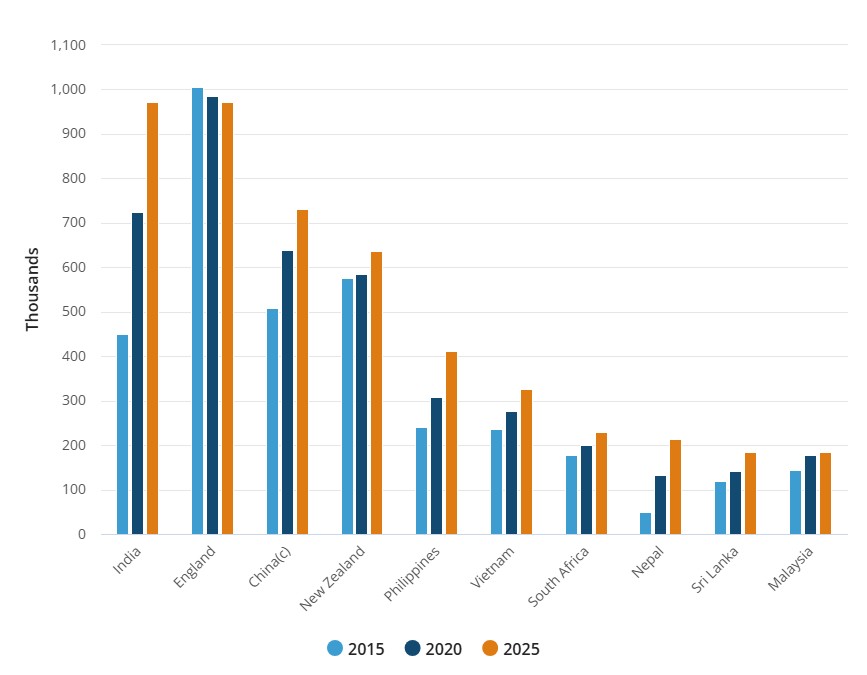
The data shows Australia’s overseas-born population increased by 258,000 people in 2024-25 and the proportion of overseas-born increased to 32.0 per cent, up from 31.5 per cent in 2024 and up from 29.3 per cent in 2021.
People born in India (971,020) were the largest group born overseas for the first time on record, after a continued increase over the last four years.
People born in England (970,950) made up the second largest group – the second year in a row that this population has had an annual increase, after more than ten years of decline.
The third largest group was those born in China (732,000), an increase of 32,000 from 2024, when the Chinese-born population had surpassed its previous peak of 661,000 in 2019.
People born in New Zealand (638,000) were the fourth largest population, increasing from 618,000 people in 2024.
Over the past decade, the largest increases in foreign-born communities have been India, with an increase of 522,000 people, China, with a 223,000 increase, The Philippines, with a 171,000 increase, and Nepal, with a 163,000 increase.
The top four countries of birth with the largest decreases in Australia’s population between 2015 and 2025 were all European countries.
The largest decreases occurred for people born in Italy, with a decrease of 46,000 people, England, with a 36,000 decrease, Greece, with a 29,000 decrease and Germany, with an 18,000 decrease.
“In 2025, these countries of birth all had a median age of 60 or over, reflecting high levels of migration from these countries in the years following World War II. In 2024, Italy dropped out of Australia’s top 10 countries of birth for the first time since 1901,” the ABS report said.
The report shows Australia is among the top migrant hosting countries in the world
“In 2024, the United Nations estimated there were 304 million people worldwide residing outside their country of birth, making up 3.7 per cent of the global population,” it said.
“The USA had more international migrants in its population than any other country, with 52.4 million. This group made up 15.2 per cent of its total population.
“Germany was the second highest with 16.8 million people born in a different country (19.8 per cent of its population), followed by Saudi Arabia with 13.7 million (40.3 per cent of its population).
“Australia ranked eighth with 8.6 million people (31.5 per cent of its population in 2024),” the report said.
On a per capita basis, Australia is the top permanent migration hosting country because most of Saudi Arabia’s migrants are temporary and have no pathway top citizenship.
The report says Australia’s overseas-born population is growing faster than the locally born population.
“Generally, more people migrate to Australia than migrate away. This net flow of migrants contributes to the growth of Australia’s population. On average, the overseas-born population has been growing at a faster rate than the Australian-born population, since the beginning of post-World War II migration.
“Over the past 20 years, since 2005, Australia’s overseas-born population has grown at an average rate of three per cent per year. In contrast, the Australia-born population has grown annually by an average of one per cent over the same period. As a result of these different growth rates, the proportion of Australia’s population born overseas has increased from 24.2 per cent in 2005, to 32.0 per cent in 2025.
“According to the earliest population records that contain country of birth, in 1891, 32 per cent of the population was born overseas. This reflects high levels of immigration in the late 19th century.
“The proportion fell to a low of 10 per cent in 1947 due to decreased migration during World War I, the Great Depression, and World War II. The proportion then rose rapidly as a result of high levels of post-war migration. From 1971 to 2020, there was a more steady increase in the proportion of Australia’s population born overseas.
“In 2021, the proportion of Australia’s population born overseas declined. This is attributed to the COVID-19 pandemic travel restrictions and the resulting impact on overseas migration both to and from Australia. These travel restrictions were removed in 2022, and there was a subsequent increase in overseas migration into and out of Australia, most notably by people born overseas migrating to Australia.
“The proportion of people born overseas has increased each year since, reaching 32.0 per cent in 2025, up from 29.5 per cent in 2022. In 2023, this percentage exceeded 30 per cent for the first time since 1893,” the ABS report said.
Read the full report: Australia’s population by country of birth, Jun 2025 | Australian Bureau of Statistics