
 Loading tweets...


Epic refugee story revealed in new book
Bruce Wong survived Cambodia’s ‘killing fields’ and went on to become a successful businessman and global philanthropist.
His story is told in an inspirational new book ‘One More Day; Killing Fields to Kindness and Compassion’, recently launched in Melbourne.
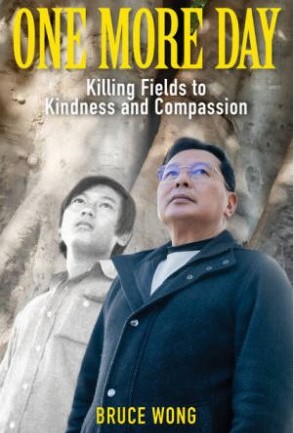 The book is an odyssey of the modern age.
As a boy, Bruce became a victim of Cambodia’s brutal Khmer Rouge regime, forced at gunpoint into back-breaking labour and denied an education and a normal family life.
He witnessed countless deaths in Cambodia’s infamous ‘killing fields’, including those of his parents and a brother.
Driven by a deep-rooted belief that a better life would come, Bruce endured disease, beatings and a sense of hopelessness.
He was sustained by an internal mantra that ‘one more day’ would bring deliverance and the chance of a new life.
Eventually, that day came and Bruce came to Australia as a refugee. He started his first job three days after arriving and went on to build a successful business career.
Bruce’s success, and his Christian faith, has motivated him to become a philanthropist, supporting multicultural communities in Australia and marginalised peoples and communities across the globe.
Driven by a profound belief in family and community, Bruce has built an ecosphere of kindness, compassion and giving around his family and friends. He is continually looking for ways to empower people who face barriers to full participation in society.
At a time of near record human displacement and when many countries are closing their borders to refugees or making life more difficult for those seeking protection, Bruce’s story is reminder of our shared humanity and of the innate empathy and kindness of the human spirit.
Bruce’s inspirational journey is emblematic of the resilience and fortitude shown by so many refugees.
And it is a reminder of the contributions a million refugees have made to the creation of modern Australia.
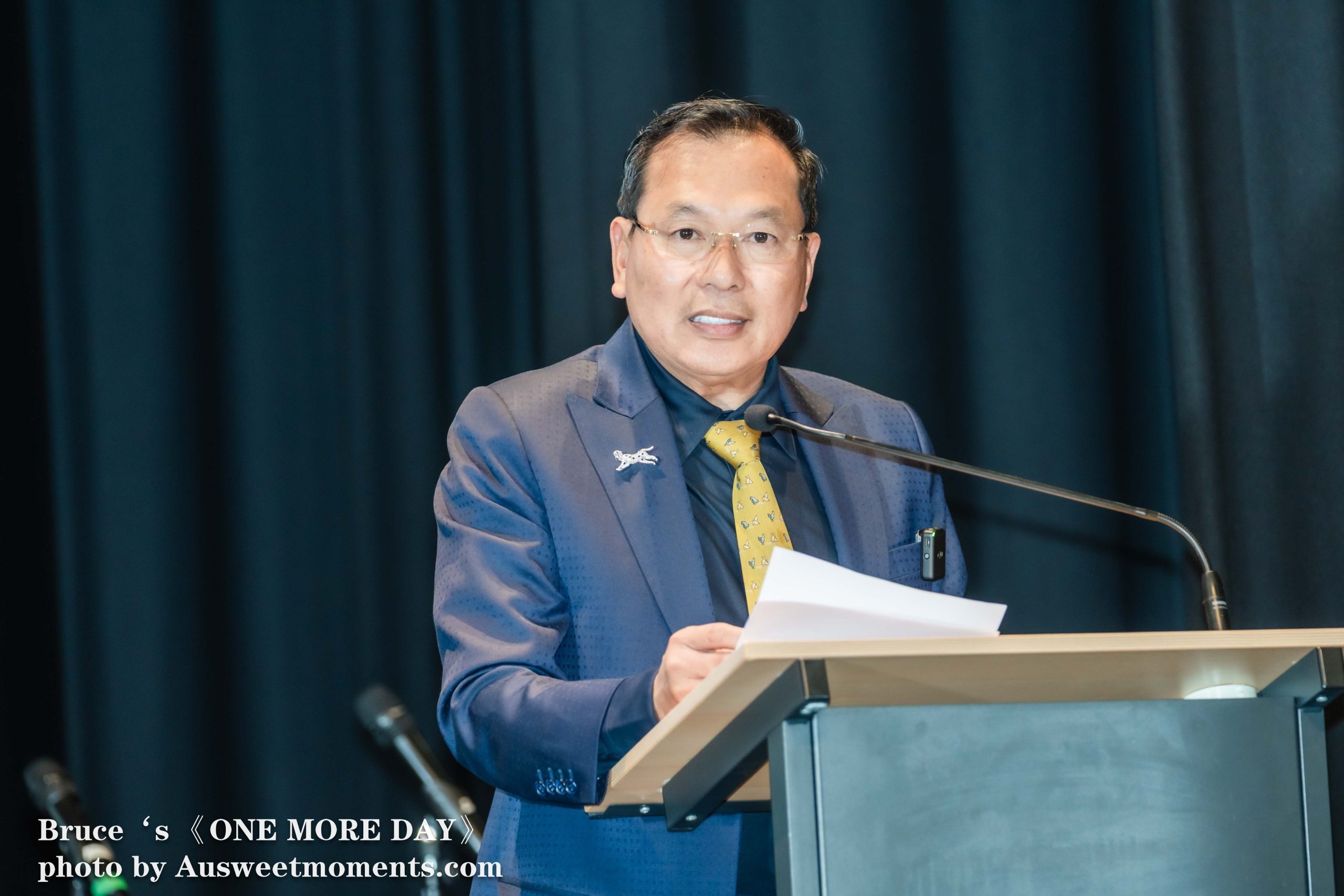 Former Victorian Multicultural Commission Chair Viv Nguyen said Bruce’s story is “a reminder of our shared humanity and of the innate empathy and kindness of the human spirit”.
“Trauma from war and conflict is a lifetime suffering. Witnessing the atrocity unleashed by the Khmer Rouge scarred Brice’s heart and soul for life. This suffering, though, has transformed Bruce into a person of compassion with a philanthropic heart and a generous soul,” Ms Nyugen said.
“Thanks Bruce for sharing your story. A great testimonial for us all during this global uncertainty, that it’s the human connection that truly matters,” she said.
Former Socceroo captain Paul Wade said that Bruce’s life is “a very Australian story”.
“Bruce showed incredible resilience in overcoming the difficulties he faced in his youth. And arriving in Australia gave him an opportunity to make a success of his life,” Mr Wade said.
“Like so many refugees and migrants, Bruce worked hard to build a new life for himself and his family. Through hard work, business acumen and opportunity, he was able to give back to the country that offered him refuge,” he said.
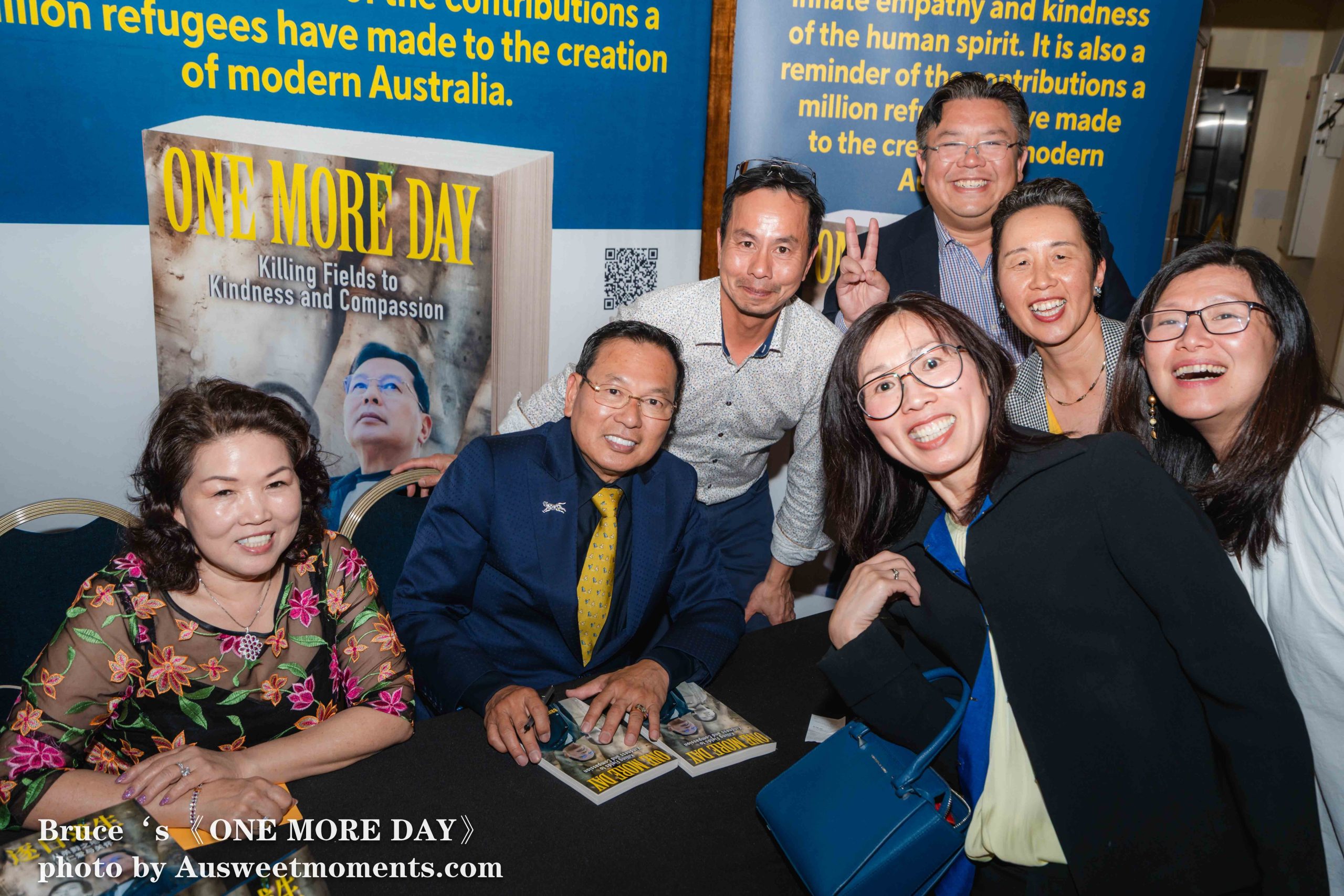 Bruce said he felt compelled to tell his story at a time when many countries are closing their borders to refugees.
“I thought it was important to share my story at time when a record number of refugees across the world are in need of support. I wanted to show that refugees are resilient and resourceful people who can make important contributions if given the chance,” he said.
“It was also the fulfilment of a promise to my family and friends, that sharing my story might give people who are on difficult journeys the hope and courage to be able to continue.”
‘One More Day: Killing Fields to Kindness and Compassion’
Wilkinson Publishing
Read an extract from Bruce’s book…
Our Liberation
It was early January 1979 and the Angkar were moving about the camp quite quickly. They had woken us in the usual way, but there had been no food prepared, and none of them were telling us to get ready for work.
Cambodia had been liberated on Christmas Day, just over two weeks earlier, though we had no knowledge of what the date was.
Suddenly, Thorn made an announcement. He spoke loudly and with firm leadership.
“Pack your things, we need to move. Be quick, hurry! The Vietnamese are coming to kill people. Hurry!”
We scrambled to our huts and grabbed our possessions, which was almost nothing anyway, and we assembled at the usual place. It was confusing to us because we were never told what was happening in the war.
We listened to what Thorn said, and we did what he told us because he sounded like he wanted to lead us to a safe place and away from whatever danger was approaching.
Passing through the small village that had become central to the work gangs, the number of people was enormous. But there, by the side of a road, to my astonishment, was my oldest sister and younger brother.
I pushed through people to get to them and grabbed hold of her tightly for a moment.
We travelled north-west in single file until we reached Pursat Province. We marched for several days, sleeping beside the road and eating the tiny amount of food we had with us.
The hunger was excruciating, but all of us felt a sense of relief that we had been able to avoid the back breaking labour we had been doing over the past three years. The distance we marched was just over 300 kilometres, and it took us something close to a month.
As we tracked along the Thai border we occasionally heard from others we met, who told us that Pol Pot had lost control of the war, and that it was ending. With no other option, we stayed together as a group along with our former captors, the Angkar, and we kept on walking for about three months.
Then, one day, we woke to discover that Thorn and the other Angkar members had gone. We were now left completely alone as a group of 40 or so boys under 18 years old.
Some of the boys began telling the group the things they knew or had overheard the Angkar saying. They told stories of Phnom Phen falling, and of Pol Pot vanishing.
After a time, some of the boys decided they would head back to the capital city to begin searching for their families. We were still in the middle of the jungle, but we had been coming across other people along the journey, and soon we found ourselves among a large number of people.
Foraging for food became a huge part of our collective focus, with the occasional edible plant being stripped to the stalk as soon as it was found.
Over the following weeks I found myself on the Thai Border. It was thick jungle, and together with hundreds of others we began pushing further along towards Thailand on a slow, exhausting march.
We developed a new pattern of travelling in that time that took advantage of the natural features of the steep hills and valleys. Each day we could push toward the top of a mountain, giving us a glimpse of the endless terrain in front of us, and we would then push back down the hill towards the valley at the bottom to spend the night.
The valleys always had rivers of clean water at the bottom, and they trapped a little bit more warmth at night than the hilltops did.
It was on this track that I was taught by some of the other refugees how to find natural resources in the jungle. I learned to cut a particular type of young tree, a sort of cane tree, that held water.
But it could only produce water if it was cut on a particular angle. Cut it straight, and no water would come from it. But cut on the right angle and it would trickle with a few mouthfuls of clean water that also had a small amount of the tree’s natural sugars in it.
As I look back, I don’t know for sure if any of the hundreds of people we were with knew where they were going.
The only thing we all seemed to agree on was that we wanted to stay away from the main roads in case militants were coming or going. None of us were fighters. We were all just normal people.
Children, mothers, parents, elderly. Starvation was always chasing us in that three-month period. A number of people simply didn’t wake up, and bodies mounted up at the bases of trees as we went on. The hills of Pursat are now thought to be haunted as a result.
Adding to the huge numbers of people who died in those hills, right-wing militants had killed thousands of people in and around the area while we were there, in massacres that were aimed at the left-wing affiliated groups in Pursat.
On several occasions gruesome atrocities happened around us. Whole families were forced to the edge of shallow ditches, where they were clubbed on the back of the head with bamboo.
The journey back to Phnom Penh felt much faster than our exodus away from it had been nearly 4 years earlier. I had thought a lot about how we were pushed out of our home as a family.
Now, as we walked into the outskirts of the city, it was clear to me that the war had made its way there. Not because the buildings were decimated like post-World War II Germany, but because it had been completely evacuated by the Angkar.
In contrast to my memories of its bustling, loud, vibrant spirit before we were pushed out into the countryside, walking into Phnom Penh was like entering a ghost town. We weren’t the first to arrive, but we weren’t far behind those who got there first.
As we entered one of the first streets that I felt like I remembered, I was overwhelmed by the complete lack of sound. In particular, the sound of vehicles and animals.
There was no beeping of car and motorbike horns, no dogs barking or roosters crowing. Just a low and distant rumbling sound of people who were rummaging through the now empty buildings.
As I look back on that day when we walked back into Phnom Penh, I’m still amazed. We didn’t know why we were there. Both our parents were now gone, and the three of us were all we had in the world.
But we returned there in the belief that we would again find a life there that had some sort of link to our past, our sense of family and our ability to belong.
Yet, what we found was a truly terrifying scene of empty, looted buildings that gave us no hope at all that we would find our place there or any sense of belonging.
It was about 3pm when we stopped walking. My sister turned to me and our brother, and she looked at us both. We were filthy, with dirt all over us, and we were literally starving. I don’t know for sure, but I could imagine that all she was thinking about at that moment was how she was going to find food for us to eat.
We hadn’t eaten since the day before when we’d had a small amount of wild food we found growing near a roadside. Although we were all starving, the gnawing and debilitating feelings of hunger were already quite familiar to us.
It was at that precise moment, as my sister stared at us, and we stared back at her, that the first of many miracles happened. And I say miracles, because I simply couldn’t believe that what unfolded could possibly happen in a world that was ruled by chaos.
As my sister stared at us, a light breeze swept through the street and reminded us that we weren’t only hungry, dirty and tired, but we were also going to be cold when it got dark.
I watched her as her gaze moved from us to the street around us. My brother sat down near where we were standing, and my sister stared down the road that led toward the city.
“Let’s keep looking,” she said, and my brother stood back up. He was so little, and he looked so tired. I put my hand out and pulled him up. He gave a half smile, and we started to walk.
It was at that precise moment, after only taking three or four steps, that she stopped dead in her tracks. We stopped behind her and instantly began looking all about for the threat that had made her stop walking.
Nothing seemed out of the ordinary to me, but as I looked about all I could see was a lady about 50 metres away who was sweeping the steps at the entrance to a two-story building.
My sister looked at me and my brother quickly, snapping a glance at us, then said “quick, hurry!”
We followed her quickly, as she walked at a hurried pace across the road and toward the woman with the thatched broom.
“Aunty!” my sister yelled as we approached. “Aunty!”
The woman looked up and focused her eyes on us. Her face was gaunt, and she looked as sick, emaciated and tired as we did, but there, in front of us, I could see the woman who had once been our father’s stepbrother’s wife’s friend.
We came to know her as Aunty Eng. It was a moment that none of us could believe. My sister took her hands, and we all laughed. She asked us where we had been, where the others were and we talked for a very long time there on the street.
Finally, after nearly half an hour, she seemed to realise the dire situation we were in, and she told us to come inside.
The block Aunty Eng and her family lived in was small, but their generosity was unlike anything we had expected. They made us a meal of rice with some thin threads of chicken and some boiled vegetables on top.
It was a luxury unlike anything I had experienced in a long time. The second miracle happened over the following weeks, as these beautiful people cared for us, and nurtured us back to health.
They wrote to Hoa, our father’s stepbrother in Vietnam. My sister and Aunty Eng wrote to our uncle, my mother’s younger brother, and he sent some money back to us to help us on our journey.
His generosity meant that we could contribute to the household costs and continue staying with our adoptive family for long enough that it probably saved us from dying from starvation.
Even though my uncle had his own family to support, and the area he lived in was equally as ravaged in places, he still gave us such generosity that I am still amazed by him.
About two months after we began living there, he sent for me to go to him in Vietnam. I was chosen for a number of reasons, but in particular because I was male, and the eldest boy in our family.
I travelled to him in a boat up-river, arriving the following day. It was a tiring journey, but when I arrived, I almost instantly realised why he had sent for me. He met me at the riverside where the boat docked.
The jetty we stopped at was impossibly small, rickety and made me very nervous when I stepped out from the boat onto it. My uncle smiled at me and extended a hand. It felt light and surreal to be with family again in that way; family who were willing to show me kindness, belonging and help. It was a feeling I couldn’t compare.
After meeting his family, and feeling even more connection to them, he took me for a walk. We had just eaten dinner, and the sun was setting.
I felt that I knew what he was going to say before he said it. He knew that I was hoping he would invite me and my siblings to come and live with him in Vietnam.
But after seeing his family, the impossibly small home they lived in, the intensely crowded streets around them and the lack of resources they also had to suffer through, I knew that there was just no way we could go to live with them.