
 Loading tweets...


Facing life’s challenges with a smile
Dalal Altaji’s life has been 51 years of constant struggle.
A struggle to overcome her disability, a struggle to access and complete her education, a struggle to survive the devastation of Israel’s attacks on Gaza and, more recently, a struggle to build and life and career for herself in a new country.
The experiences of thousands of Gazans caught up in the conflict have been tragic and devastating but for Dalal they have been particularly challenging because she has been totally blind from birth.
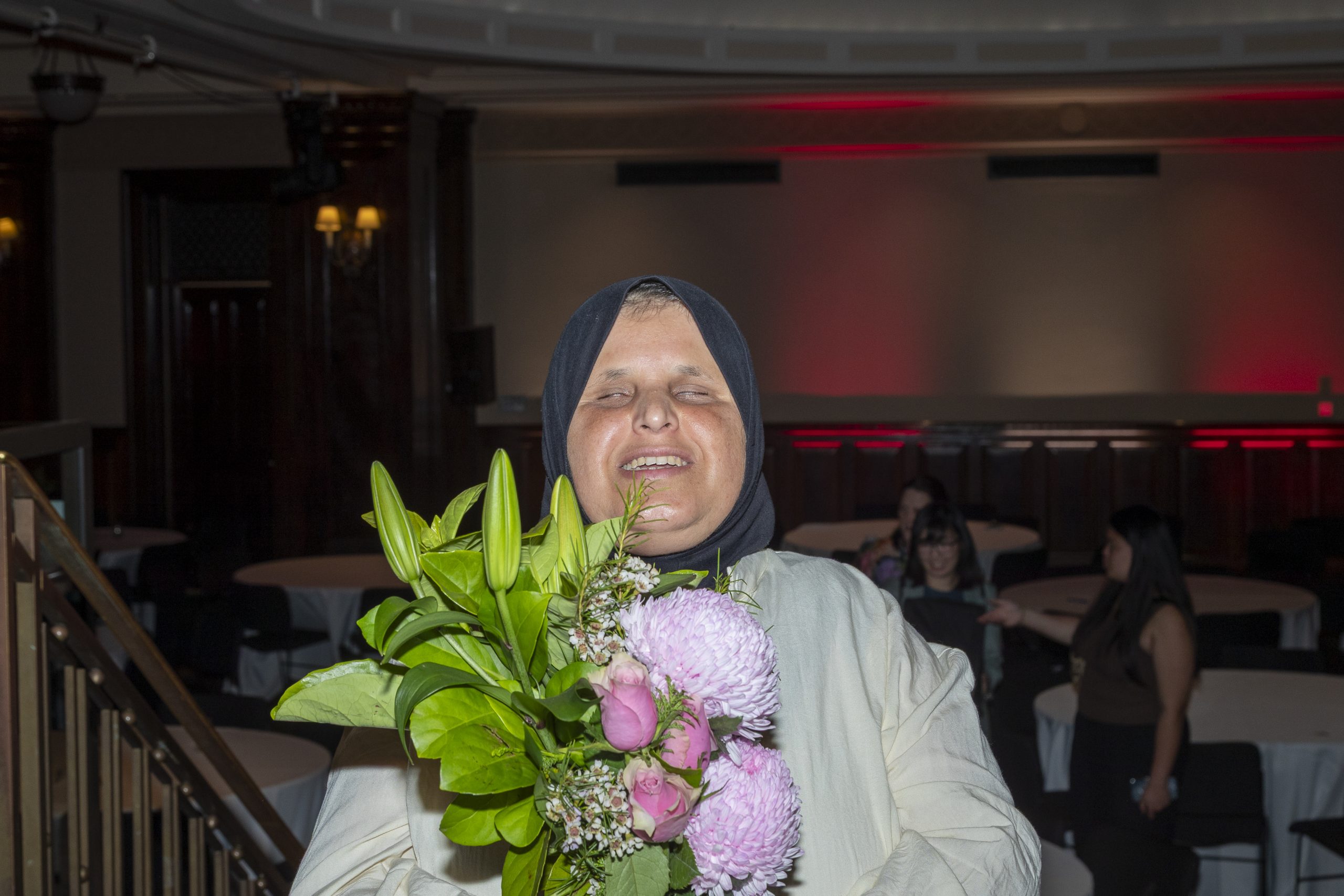 She says her inspiration to surmount these herculean challenges was her memory of her mother’s advice to “keep smiling”.
Now living in Melbourne, Dalal has reflected on her remarkable life, the devastating conflict in Gaza and her epic journey to safety.
“The outbreak of the conflict and violence in Gaza was very frightening. I could hear what was going on but not see it,” she said.
“The main problem was displacement. Moving from one place to another constantly. By the timer I had learned how to navigate one place, I would have to move on. I couldn’t rest.
“We constantly had to think about survival. How to find water, food and shelter.
“On October 10, three days after the start of the conflict, I was sitting in my house. I got up and was thinking of making a cup of tea when the house behind us was bombed.
“All the glass in our house was broken. My brother lived in an apartment downstairs from me. He knocked the door, but it wouldn’t open. It was difficult and frightening time,” she said.
In another incident Dalal lay asleep in a makeshift evacuation centre in Gaza when her world exploded.
The building next to the evacuation centre was obliterated by an Israeli bomb, shattering the windows of neighbouring buildings and rocking the neighbourhood.
“In that moment as I woke up suddenly, I thought I was dead. Then I reached out and felt the wall next to me and I realised I was still alive,” Dalal said.
“It was a very, very frightening time, but in that moment, I realised that I had survived and that I would survive,” she said.
Dalal says her decision to leave Gaza was very difficult.
“I didn’t know if I would ever come back or not. And I was leaving my brother and friends behind,” she said.
Dalal was identified by the Red Cross as a vulnerable person and, with a connection living in Queensland, she received a visa to come to Australia.
But the development was academic because all of Gaza’s borders were closed.
“I got the visa in June 2025, but the question was ‘how do I get out?’ At that time, it was difficult. The borders were closed, and you had to coordinate and pay money,” Dalal said.
“I had originally registered at the Egyptian border and paid the money and then the border closed,” she said.
“Then the ceasefire of January 19 happened. I was wondering again whether I should go or stay. I was thinking ‘if I stay, will it be OK?’
“Then in March 2025 I got a call from the Australian embassy in Jordan. They said that in days I had to travel.
“With the preparations need, I effectively had just an hour to make up my mind. In the end I went with the ICRC to the border with Jordan. I spent two days there and was on a plane to Australia.
“I was constantly thinking ‘am I doing the right thing?’ Dalal said.
She arrived in Queenland, where her sister lives, amid an approaching cyclone. Dalal then moved to Melbourne to seek opportunities.
Dalal’s early years were almost as difficult as the last few. She was born in Lebanon to Palestinian parents, but she lost her mother when she was baby.
Brought up by a Palestianian charity, Dallal lived the first years of her life in the charity’s hospital.
“An Australian women volunteering at the charity saw that I had a disability and she became my mum. That women was Jean Calder, and she passed away three years ago,” Dallal said.
“It was a Jean’s sister who supported my application to come to Australia,” she said.
She told of the challenges she faced as a child growing up amid turbulent times in the Middle East.
“I have been totally blind from birth which has been a gig challenge. I initially went to an Anglican school but had to stop for two years because of the war there and in 1984, I went to Egypt.
“There I me my first challenge. In Lebanon I used the Braille Perkins typewriter but in Egypt I had to write the old way dot by dot. I was told that if I didn’t learn their way, I would have to go back to primary school.
“I spent the whole summer learning to write Braille and I finally was able to go to high school,” she said.
Dallal returned to Palestine and, in 1995, entered Gaza university to study English literature.
“It was a shock, a completely different world. I was a blind person learning with sighted people. In 1995, inclusiveness and disability were not talked about,” she said.
“I was the first blind student at my university to study English literature. My lecturer told me I should be studying Arabic or Islamic law. But I insisted, and I repeatedly convinced the university to let me continue. And I was able to pass by my own efforts.
I just wanted access and every term I had to fight for access. I persisted and eventually graduated.”
After university, Dalal looked for a job and work as an interpreter for a time.
She won a scholarship to Edinburgh University to study social anthropology.
“This led to me working as a lecturer, teaching people without a disability how to work alongside people who a disability,” she said.
Dalal also taught special education and policy of inclusion, becoming in 2014 one of the first people in Gaza to work in this field.
But her career hit a hiatus in 2023 when the Gaza conflict began. Now Dalal is seeking to restart her working life.
“I feel better now and settled in Melbourne. But sometimes I feel down and miss my brother and friends,” she said.
“I want to find a job and move on with my life. Eventually I want to work in my field and apply to do a PhD,” Dala said.
She says she has a passion to use her academic work and her lived experience to make a contribution in the field of inclusion.
A demonstration of this is how Dalal says she sometimes says to people ‘it’s sunny today.’
“They say to me, ‘it’s sunny, how do you know’,” she says.
“This is my opportunity to send out my favourite message. It’s an opportunity to explain that ‘we are all the same.’ We can all feel the sun on our faces.
“Inclusiveness is not only for people with a disability, it’s for everyone,” she says.