


 Loading tweets...


New immigration arrangements revealed
The federal government will tighten temporary visa rules in a bid to reduce annual net overseas migration from about 300,000 to 225,000 people by 2028.
The government’s new immigration policy will also include an effective ban on international students bringing family members to Australia.
Last financial year, 337,427 student visas were granted. Of those, 45,991 went to secondary applicants, classed as dependents or family.
 Overseas students will not be allowed to extend their stay in Australia by switching to less rigorous courses to stop visa hopping. They will be allowed to extend their study period and transfer to different, but equivalent, courses.
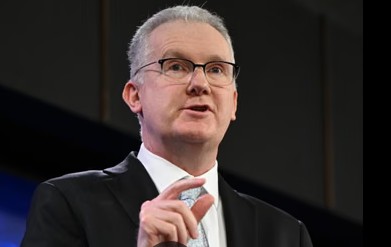
The new arrangements were outlined by Immigration Minister Tony Burke in speech at the National Press Club.
Minister Burke acknowledged the economic importance of overseas students.
There will be changes to the skilled migration points test to prioritise areas where Australia suffers skills shortages, including construction, agriculture, fisheries, resources and teaching.
There will also be prioritised visa processing in these areas of skills shortages.
Numbers of working holidaymaker visas issued will be reduced through a ballot system that will apply in the second and third years. Visas available in year three of a working holiday visa will be reduced from 31,000 to 5,000.
And people on visitor visas will have no avenue to extend their stay.
But none of these reforms will apply to people already here.
Disingenuous protection claims will be targeted and detention and deportation practices that existed before 2015 will be reintroduced. This will see a crackdown on visa hopping and the ramping up of deportations.
There are currently 77,000 visa overstayers in Australia.
Minister Burke said an additional 100 compliance officers and 250 extra detention beds will be commissioned. But he said it would not amount to an ICE-style operation currently is use in the US.
He said the move would bring behavioural change, with people without valid visas making their own decisions to leave.
There will also be changes to the code governing migration agents who will face sanctions if they are found to have abused the system by facilitating visa hopping.
Minister Burke said Australia’s humanitarian protection system was sacrosanct.
“People who have legitimate fears of persecution, or worse, should absolutely be supported and protected by our humanitarian system. We saw this at work recently in case of the football players from Iran,” he said.
Minister Burke said the new arrangements did not go as far as he would have liked and would be implemented through regulation not legislation because the government would struggle to get legislation through the Senate.
He said Australia’s migration issues stemmed from “demand driven” immigration that stemmed from the Hawker and Howard governments.
“We brought in increasing numbers of workers and students, but housing and infrastructure didn’t keep pace,” he said.
Minister Burke rejected arguments that immigration was to blame for housing shortages, saying that home occupation rates had fallen.
“At the time of the Hawke government, the number of people per household was 2.9. now it’s 2.5,” he said.
“A 0.1 per cent change decrease in house occupancy means we need an extra 450,000 homes. Immigration needs to be part of the solution to this.”
Minister Burke rejected recent assertions that Australia is witnessing ‘mass migration’, saying that current projections would see the population in 2031 would be 700,000 lower than was projected before the COVID-19 pandemic.
He said that drastic cuts to immigration would hurt the economy and the national project to build more housing.
“You can’t build a house without plasters and two thirds of plasterers in Sydney and Melbourne were born overseas,” he said.
“The number of construction workers who have come as migrants has tripled to 15,000 over the past year.”
Minister Burke said the concept of was a ‘fundamental strength” for Australia and the ultimate expression of an immigration journey was a citizenship ceremony.
“It is part of the fabric of modern Australia and while some people use the word melting pot, I prefer the term orchestra because what we are about is working together to build harmony,” he said.
Minister Burke said government would continue control of the migration system but would treat individuals with the fairness and decency that Australians expect.
“The government supports immigration but is opposed to anyone rorting the immigration system,” he said.
“Almost everyone who comes to Australia is a good guest in our country. These reforms are to ensure that our migration system can be better targeted to the current needs of Australia.”
Meanwhile, figures released by the Australian Bureau of Statistics today show the migration growth has eased.
Net overseas migration in the year March 2026 was 292,100 – a decrease of 17,400 (5.6 per cent), on the previous year bringing Australia’s population to 27,921,150, according to ABS data.
This figure does not include people on temporary visas. More than a million temporary visa holders in skilled, student or working holidaymaker categories arrived in Australia last year.
There are now more than three million temporary migrants in Australia.