



 Loading tweets...


Rethinking the global displacement crisis
Refugee resettlement in third countries is now not a durable solution to the global crisis of human displacement, according to former Assistant Secretary of the United Nations Professor Gillian Triggs.
Professor Triggs said there were 117 million displaced people around the globe and 42 million who were deemed to be refugees.
But at current rates, just 0.5 per cent of these people will ever be resettled, she said.
Speaking at the recent Refugee Communities Association of Australia (RCAA) conference in Adelaide, Prof Triggs said ‘big thinking’ and new solutions were needed.
“It is a grim picture. There are wonderful stories of people resettling but in comparison to the need, they represent so few people,” she said.
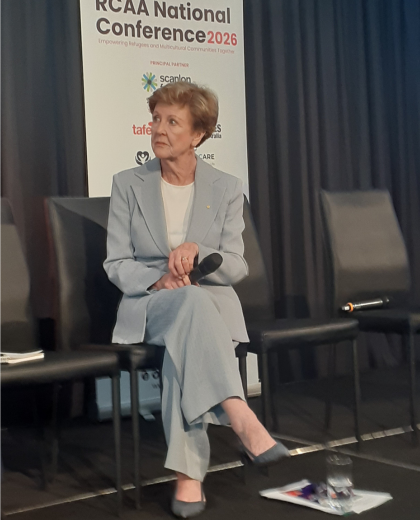
Professor Gillian Triggs
Prof Triggs said new solutions were needed across a range of localised circumstances.
“We need big thinking. This needs to include local communities offering support, opportunities through education and employment support,” she said.
“There are also potential opportunities in route-based solutions where support is provided along migration routes. And the Global Comact on Refugees can also play a role.”
Prof Triggs said the World Bank particularly had been working on stabilising populations where they are safe.
“We have seen a great example of this in Kenya where there are huge refugee camps that are being transformed into viable towns and cities,” she said.
“The President of Kenya declared that people in the major camps should be integrated into the local community.”
“And the World Bank has funded access to medical care and opportunities to start businesses. This has effectively amounted to empowering refugees in places where it was safe so they can build lives and transform camps into viable cities.”
Prof Triggs said route-based approaches means supporting migrants and refugees along their journeys.
“Refugees mostly move in certain familiar routes, or well-trodden pathways. Rather than focusing on one country, this approach looks at protection needs across the entirety of these routes.
“These are creative big picture solutions and Australia is well placed to help implement them.”
Prof Triggs Australia’s intake of around 20,000 refugees a year was a “global example and extraordinary contribution”.
“Australia was a key player in the formulation of the 1951 Refugee Convention and, since then, we have been welcomed a million refugees,” she said.
Prof Triggs said that following World War II, global resettlement arrangements had seen the long-standing practice of settling refugees in third countries permanently and with rights comparable to native-born people.
“And people fleeing to neighbouring host countries are not always safe there,” she said.
“What happens is that UNHCR assesses their needs and recommends a host country that might be suitable for them.
“In 2023 the largest receivers of refugees were the US with 75,000, Canada at 51,000 and Australia with 20,000.
“Now that process is close to collapse and the funding of programs has also effectively halted. Refugee settlement is close to zero.
“The problem is exacerbated by the fact that the greatest number of refugees are being hosted by equipped for resettlement and with struggling economies. Many struggle to undertake the role of hosting refugees,” she said.
Prof Triggs said the world was facing “deeply troubling times”.
“I have never seen the world on fire the way it is now. I’m despairing when I see the conflicts in Sudan, the DRTC, Ukraine, Pakistan, Afghanistan, Iran, Palestine, Lebanon and elsewhere,” she said.
“And this is all exacerbated by other factors such as economic instability and climate change.
“At the same time there is a declining respect for international law. And the established global principles of human rights and refugee protection are at risk from a small number of states.
“The challenge is huge, and refugee voices are needed now more than ever.
“And when you understand how the toxic the global refugee situation is, it means local groups are more important than ever,” Prof Triggs said.